Was the Brabham fan car banned?
Yes, though it was never found to have broken the rules. The Brabham BT46B won its only race, the 1978 Swedish Grand Prix, after the stewards rejected every protest against it. Bernie Ecclestone then agreed to withdraw it, and on June 23, 1978, 6 days after the win, the CSI banned fan cars outright, on safety grounds.
The CSI was the sporting commission that ran Formula 1 rules at the time. Both halves of the story are on the record, which is why people still argue about it. The car’s designer, Gordon Murray, has spent decades saying it was never banned. The contemporary report in Motor Sport says the CSI banned it anyway.
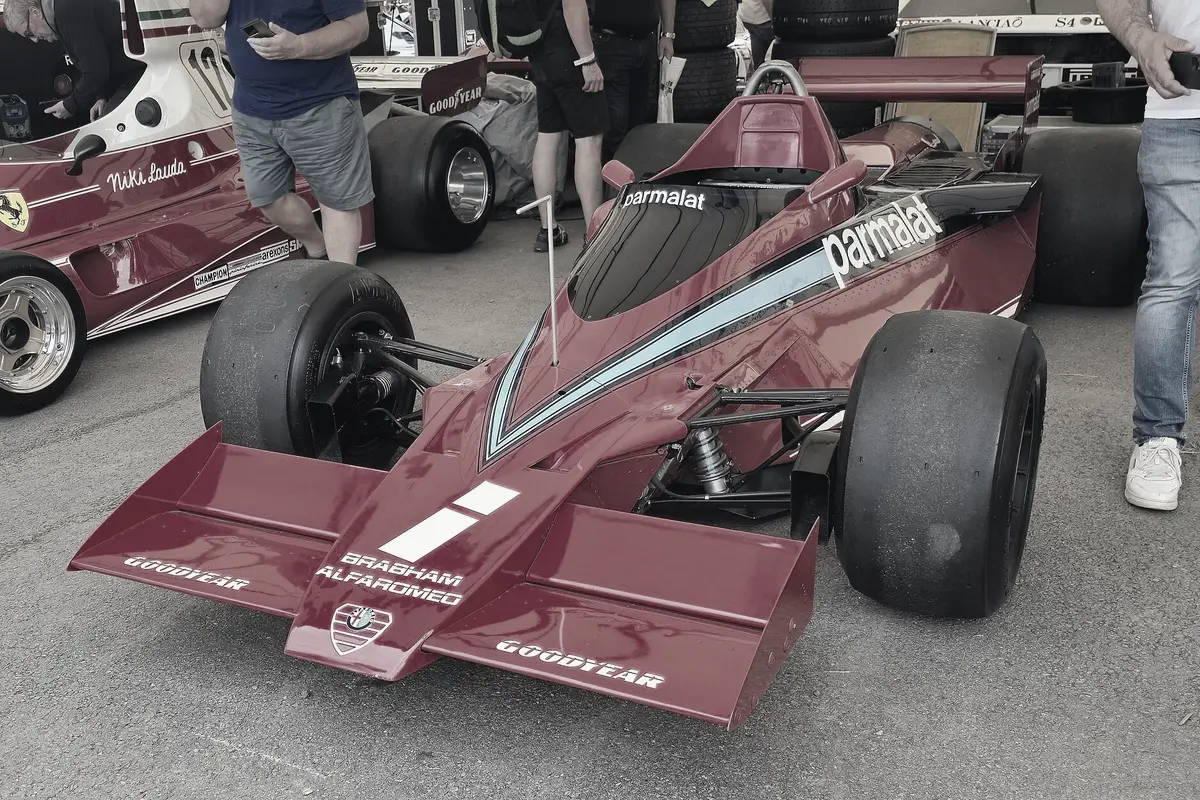
Brabham-Alfa Romeo BT46B, the 1978 fan car, at Goodwood in 2024.
Photo: Calreyn88, CC BY-SA 4.0, via Wikimedia Commons; colour-graded and cropped by The Second Grid (this adaptation is licensed under the same licence).
How the fan car worked
Brabham had an Alfa Romeo flat-12 engine for 1978, and it was too wide for the venturi tunnels that made Lotus’s ground-effect cars so fast. Murray found another way to lower the pressure under the car. He sealed the engine bay and the underside with skirts, laid the radiator flat on top of the engine and fitted a large fan at the back, driven from the gearbox. The fan pulled air through the radiator and out from under the car.
The fan drew air through a radiator laid flat on the engine and out of the sealed engine bay and underside, so the car was pulled down whatever its speed.
Source: Motor Sport (Denis Jenkinson, August 1978; May 1998)
That made downforce that depended on engine speed, not road speed. “Because it was not speed dependent, at a hairpin you could have miles more cornering force,” Murray told Motor Sport in 1998. The Race puts the power needed to drive the fan at around 30bhp.
The legal case rested on two words. The rules banned movable parts that affected the aerodynamics, but only where that was their primary function. Murray’s numbers said the fan did 70% cooling and 30% ground effect, and a CSI technical commission that inspected the car found figures that agreed “more or less” (Motor Sport, August 1978). The cooling share has drifted with each retelling since: in 2019 Murray put it at “more than 50 percent”.
One race, won by 34 seconds
Before the race at Anderstorp, Lotus, Tyrrell, McLaren and Surtees lodged a joint protest and Williams added its own. The Swedish stewards rejected all of them and let the cars race.
1978 Swedish Grand Prix, top 3
| Pos | Driver | Car | Gap |
|---|---|---|---|
| 1 | Niki Lauda | Brabham-Alfa Romeo | — |
| 2 | Riccardo Patrese | Arrows-Ford | +34.019 s |
| 3 | Ronnie Peterson | Lotus-Ford | +34.105 s |
Source: Formula1.com: 1978 Swedish Grand Prix race result
Brabham tried to hide how fast the car was. Lauda later wrote that he and John Watson “drove the qualifying laps with full tanks and did our level best to avoid pole position”. Mario Andretti’s Lotus took pole anyway, with Watson second and Lauda third.
In the race Lauda passed Andretti when the Lotus slid on oil, and won by 34.019 seconds from Riccardo Patrese’s Arrows, according to the official result. The figure of 34.6 seconds that circulates online is wrong. Ecclestone’s own verdict was blunt: “I could have driven it and won.”
Six days in June
The pressure came from the other teams in FOCA, the constructors’ association Ecclestone led. On Thursday June 22 he chaired a FOCA meeting that ran six and a half hours and gave in. Under the compromise, the protests would be dropped, the fan car would race in France, Britain and Germany, and Brabham would then retire it after August 1.
The CSI commission’s vote on the FOCA compromise, June 23, 1978
2–2
Dean Delamont and Huschke von Hanstein voted to let the fan car race on until August; Alberto Rogano and Jean-Marie Balestre voted against. Chairman Pierre Ugeux’s casting vote threw the compromise out.
Source: Motor Sport (Denis Jenkinson, August 1978)
The next day Ecclestone and Colin Chapman of Lotus took the deal to a special CSI commission in Paris. Its 4 voting members split 2–2, and the chairman, Pierre Ugeux, used his casting vote against it. Motor Sport’s Denis Jenkinson reported the outcome the following month: fan cars were banned “from the date of the meeting, June 23rd, 1978”, for reasons of “safety”, and the Swedish result would stand. His summary is the fairest one-line answer to the question: “the BT-46B was not illegal, according to the letter of the law, but the CSI banned it none-the-less.”
At the next race, in France on July 2, Brabham ran the standard BT46.
Why Murray says it was never banned
Murray’s version starts before the CSI meeting. In 2019 he told Motor Sport that he still has a letter from the CSI saying the car was “absolutely legal” and could run to the end of the year, after which the loophole would be closed. In his account it was Ecclestone who asked him to withdraw it, because Chapman, Tyrrell and the other constructors were putting him under “massive pressure”. “It was never banned,” he said.
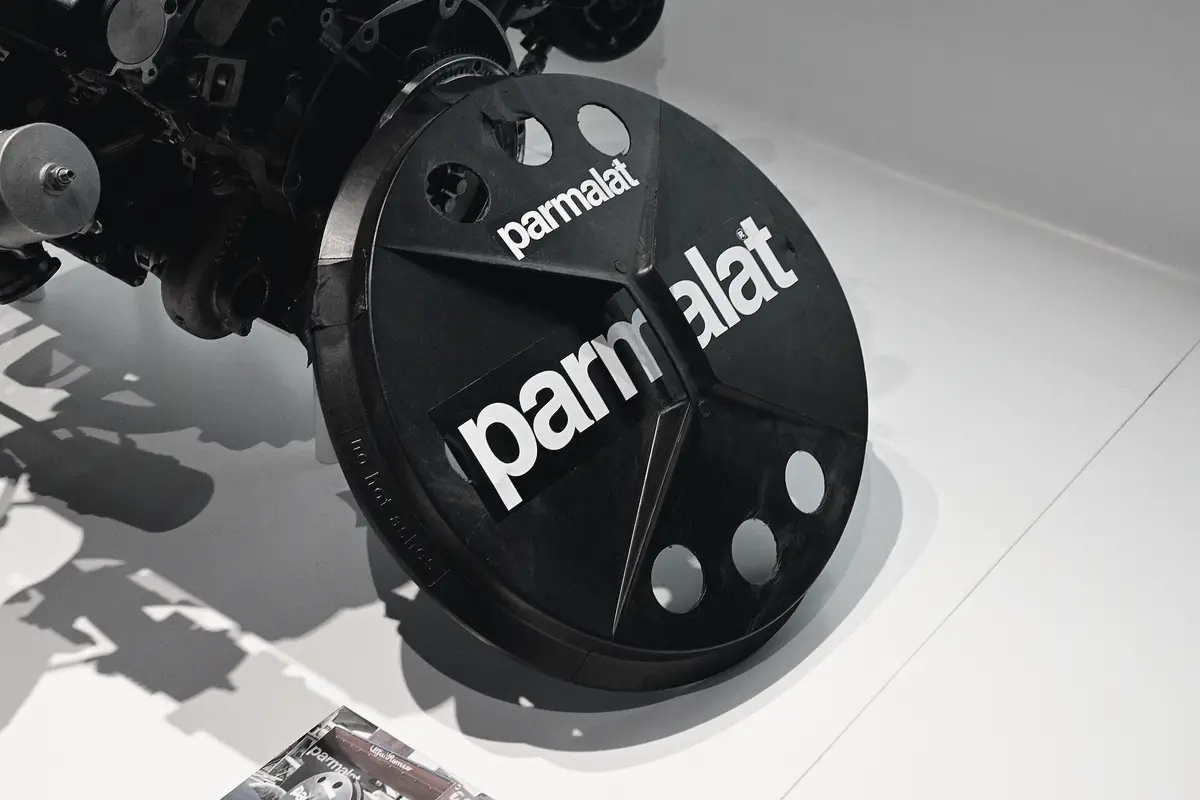
A reproduction of the improvised cover Brabham’s mechanics used to hide the fan from photographers at Anderstorp: a dustbin lid that happened to fit. Formula 1 Exhibition, London.
Photo: Hullian111, CC BY-SA 4.0, via Wikimedia Commons; colour-graded and cropped by The Second Grid (this adaptation is licensed under the same licence).
Both accounts can be true at once. Brabham did withdraw the car, and no steward or court ever ruled it illegal. The CSI also did rule fans out, from the day of its meeting, before the car could race again under the FOCA deal. So it was banned, but it was never found to be illegal.
Murray has also said the decision was probably right. Others “would have gone off and tried to make fan cars very quickly, which would have been incredibly dangerous,” he said in 1998. The fan car is the 2nd of 6 cases in our article on banned F1 cars that never cheated, and at 6 days from win to ban it is the quickest end in that list for a car that had already won.
Questions people also ask
- Did Brabham keep the win?
- Yes. The CSI ruled on June 23, 1978, that the Swedish Grand Prix result would stand, and Niki Lauda’s win is in the official results.
- Was the fan car illegal?
- Not under the rules it raced under. The stewards rejected every protest, and the CSI’s own technical checks accepted Brabham’s case that the fan’s main job was cooling. Fan cars were ruled out afterwards, on safety grounds.
Key facts
| Car | Brabham BT46B, Alfa Romeo flat-12, designed by Gordon Murray |
|---|---|
| Only race | 1978 Swedish Grand Prix, Anderstorp, June 17, 1978 |
| Result | Niki Lauda won by 34.019 s from Riccardo Patrese |
| Ruled illegal? | Never. Five protests were rejected before the race |
| Gone | June 23, 1978: the CSI banned fan cars from that day; the Swedish result stood |
Sources (6, 1 primary, marked ●)
- ● 1978 Swedish Grand Prix race result, Formula1.com
- Swedish Grand Prix (Denis Jenkinson, July 1978), Motor Sport
- The Brabham-Alfa Romeo fan (Denis Jenkinson, August 1978), Motor Sport
- Vacuum clean (May 1998), Motor Sport
- Gordon Murray looks back at the notorious Brabham fan car (July 2019), Motor Sport
- Nine things you may not know about Brabham’s iconic F1 fan car, The Race
Spotted an error? Email contact@thesecondgrid.com with your source. Confirmed fixes go on the corrections log.
Related long-form episodes
All articles
Banned F1 cars that never cheated, ranked by how fast F1 killed them
Six Formula 1 cars were legal when they raced and banned anyway.
Why only 6 cars raced the 2005 US Grand Prix, and F1’s other worst rules
From Kyalami 1982 to Indianapolis 2005: 5 Formula 1 rule changes that backfired, ranked by what they cost before they were reversed.