Why only 6 cars raced the 2005 US Grand Prix, and F1’s other worst rules
From Kyalami 1982 to Indianapolis 2005: 5 Formula 1 rule changes that backfired, ranked by what they cost before they were reversed. The worst kept F1 out of the United States for 4 years.
By The Second GridChecked against 29 sources (11 primary)Updated
6 min read · 16:42 video
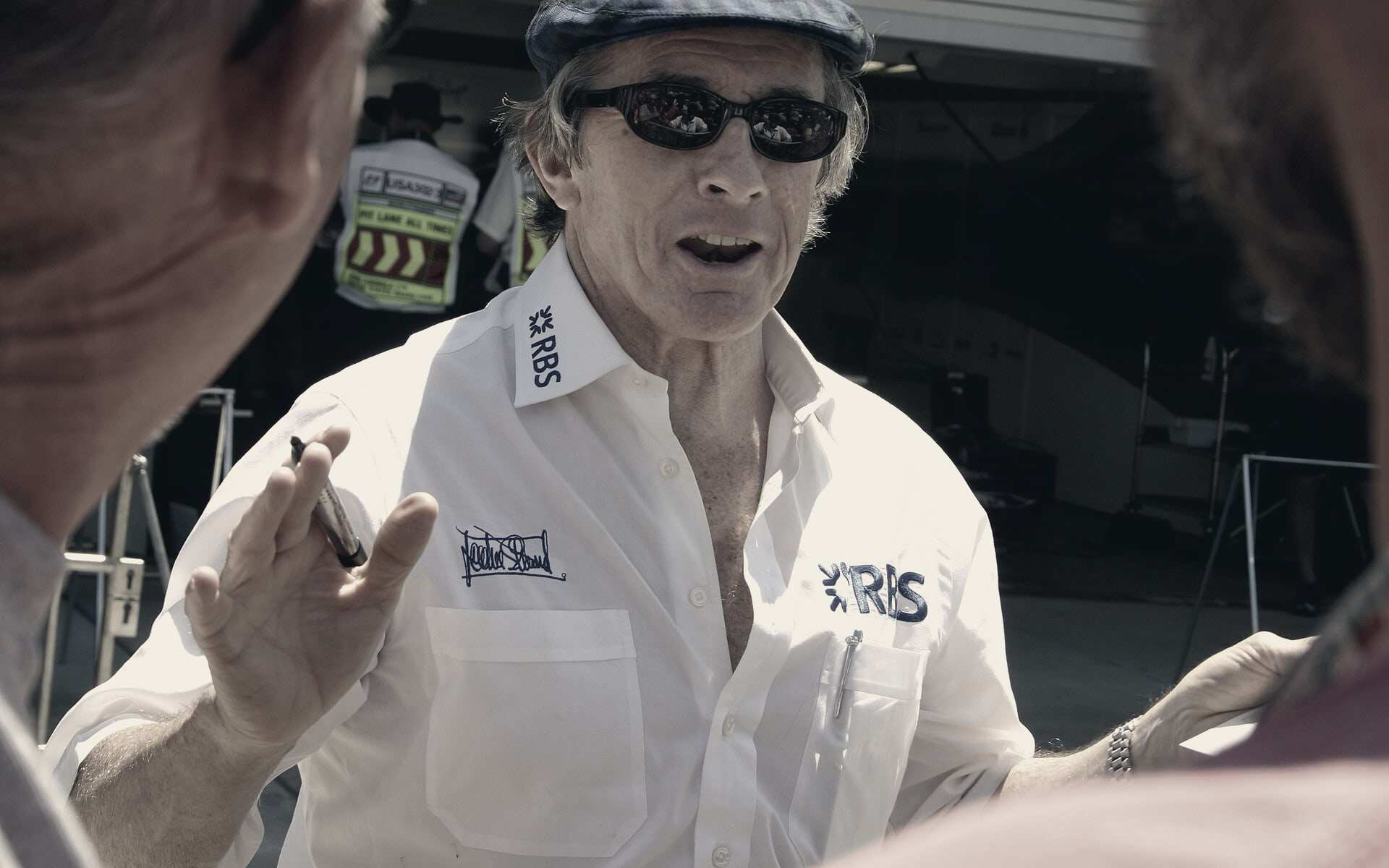
The pit lane at Indianapolis on 18 June 2005, the weekend of the US Grand Prix. Photo: RickDikeman, CC0, via Wikimedia Commons; colour-graded and cropped by The Second Grid.
Only 6 of the 20 cars that took the formation lap at Indianapolis on 19 June 2005 started the United States Grand Prix. The other 14 turned into the pit lane and switched off.
A regulation written the previous October said one set of tyres had to last qualifying and the whole race, and Michelin’s tyres could not survive the banking at Turn 13. F1 deleted that rule 12 months and 5 days after writing it. By then it had cost the sport a tyre supplier, a circuit and 4 years of racing in the United States.
F1 reverses rules all the time, so how quickly a rule goes tells you very little. A better measure is what it damaged before anyone would admit it was wrong. Here are 5, from the cheapest to the most expensive.
1982: the super-licence clause
The cheapest bad rule on this list cost one practice session, because the drivers killed it before it reached a race.
Over the winter of 1981–82, FISA rewrote the super licence, the document every driver needs to race. The new version carried a clause that would have tied a driver to a single team for up to 3 years. On Thursday 21 January 1982, the opening day of practice at Kyalami, the drivers organised.
A bus took 30 of them, Niki Lauda included, from the circuit to a conference room at the Sunnyside Park Hotel. They spent the night there on mattresses on the floor. Lauda later remembered Elio de Angelis and Gilles Villeneuve playing the piano.
Thursday practice didn’t happen. By the time the race ran on Saturday the 23rd, the clause had been dropped.
FISA then fined the striking drivers $5,000 each and handed out suspended bans. The FIA’s own court later reduced the bans and criticised how FISA had handled the dispute.
That was the whole bill: one practice session at one circuit. Every other rule here did damage before it went.
2016: elimination qualifying
Elimination qualifying lasted 44 days and spoiled 2 Saturdays before the teams got rid of it.
It was approved by the World Motor Sport Council on 4 March 2016 and confirmed by the FIA on 11 March, 8 days before qualifying in Melbourne. Drivers were knocked out one at a time as the clock ran down, so in theory there would always be cars on track and someone in danger.
In Melbourne on Saturday 19 March, Q3 ended with no cars on track at all. The front-runners had done what they needed, worked out they couldn’t improve, and stayed in. Lewis Hamilton took pole from inside the garage. A format meant to keep cars running in the final minutes had none running in the final minutes.
The teams agreed in Melbourne the next morning to drop it with immediate effect. It ran again in Bahrain on 2 April anyway, with the same result.
On 7 April the teams wrote, unanimously, asking to go back. The World Motor Sport Council made it official on 11 April, and by the Chinese Grand Prix on the 17th it was gone.
2014: double points at the final race
Double points were on the books for one season, used at one race, and didn’t change the result.
Hamilton’s 2014 title margin over Rosberg, points
Source: Formula1.com — 2014 driver standings
On 9 December 2013 the FIA announced, under a mandate from the World Motor Sport Council, that the final race of 2014 would pay double points, 50 for a win. The worry was obvious. A title earned over a whole season could be flipped by extra points at the last race.
2014 then produced the finale the rule was written for: Hamilton against his team-mate Nico Rosberg, settled in Abu Dhabi on 23 November. Four years earlier, the same circuit had settled a four-way title fight on a pit-wall call.
Rosberg’s car lost its energy recovery system and he dropped to 14th. Hamilton won the race, took 50 points and the title by 67, 384 to 317. Without double points he would have won it by 42. The rule added 25 points to the margin and had no effect on who won.
Three days later, on 26 November, the Strategy Group met in Geneva and scrapped it. It’s the only rule here that was dropped for doing exactly what it said, and its whole cost was a year of the sport arguing with itself.
2021: half points at Spa
Spa 2021 paid out points for a race with no racing in it, in a season decided by 8 points.
2021 Belgian Grand Prix, top 3 (1 lap classified)
| Pos | Driver | Team | Pts |
|---|---|---|---|
| 1 | Max Verstappen | Red Bull | 12.5 |
| 2 | George Russell | Williams | 9 |
| 3 | Lewis Hamilton | Mercedes | 7.5 |
Source: Formula1.com — 2021 Belgian Grand Prix race result
The half-points rule had been in the sporting regulations for a long time. If a race couldn’t be completed, the result stood, and below 75 per cent distance it paid half points. Laps behind the Safety Car counted as laps. Before 2021 it had been used 5 times in the championship’s history.
At Spa-Francorchamps on 29 August 2021, rain delayed the start by more than 3 hours while a crowd of 75,000 sat in it. The field then ran 2 laps behind the Safety Car before the red flag came out, and the rulebook did what it said.
The result was taken from the end of lap 1, the shortest race in the sport’s history. Max Verstappen scored 12.5 points for a win in which he passed no one. George Russell scored 9 and Hamilton 7.5. Hamilton called it “a farce”.
The fans didn’t get their money back. The promoter offered no refund. Instead, ticket holders were entered into a draw for 170 seats at the following year’s race.
The 2021 championship finished 395.5 to 387.5. Spa moved 5 points between Verstappen and Hamilton, more than half the final margin. It didn’t decide the title by itself, but it’s part of the gap.
For 2022 the rule was rewritten. No points are paid unless the leader completes at least 2 laps without a Safety Car or Virtual Safety Car, with a tiered scale after that.
2005: the tyre rule that cost F1 America
The single-tyre rule is the one F1 kept paying for after it was gone.
2005 United States Grand Prix: every classified finisher
| Pos | Driver | Team | Laps |
|---|---|---|---|
| 1 | Michael Schumacher | Ferrari | 73 |
| 2 | Rubens Barrichello | Ferrari | 73 |
| 3 | Tiago Monteiro | Jordan | 72 |
| 4 | Narain Karthikeyan | Jordan | 72 |
| 5 | Christijan Albers | Minardi | 71 |
| 6 | Patrick Friesacher | Minardi | 71 |
Source: Formula1.com — 2005 United States Grand Prix race result
On 21 October 2004 the World Motor Sport Council imposed the 2005 regulations, in force from 1 March. One set of tyres had to last qualifying and the entire race. The FIA’s stated reason was that a harder tyre would cut cornering speeds. What nobody priced in was that a tyre you aren’t allowed to change can’t be changed when it starts to fail.
At Indianapolis on the Friday, Ralf Schumacher’s Toyota crashed heavily at Turn 13 after a tyre failure. Michelin then told the teams that at racing speed through that banked corner, its tyres were safe for about 10 laps.
Michelin asked for a chicane before the banking. The FIA refused. It would not sanction a race on an altered circuit, and the 3 Bridgestone teams had brought tyres that worked.
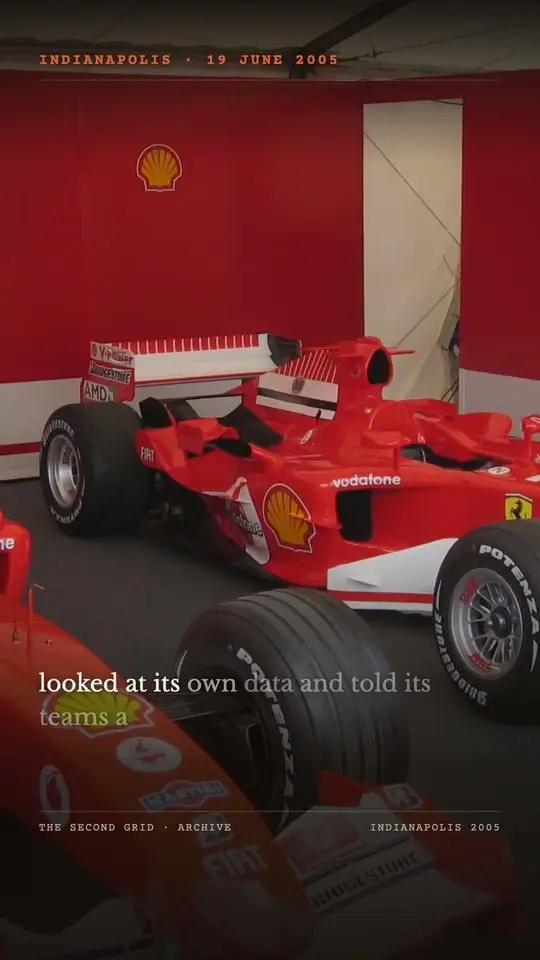
On Sunday 19 June, in front of a crowd estimated at 100,000 to 130,000, the 14 Michelin cars peeled into the pits at the end of the formation lap. Only 6 cars raced: 2 Ferraris, 2 Jordans and 2 Minardis. Michael Schumacher won, and Tiago Monteiro finished third.
Michelin refunded everyone who attended, then bought 20,000 tickets for the 2006 race to give away. At the end of 2006 it left Formula 1.
On 26 October 2005 the World Motor Sport Council restored tyre changes for 2006. That fixed the rulebook but not the damage. Indianapolis was dropped after 2007, and from 2008 to 2011 there was no United States Grand Prix at all. It took a new circuit in Austin in 2012 to bring F1 back.
Only one was reversed too late
Every rule here was reversed, so that on its own tells you little. The 1982 clause was dead in 2 days. Elimination qualifying lasted 44. Double points went 3 days after its only race. The half-points rule was rewritten the winter after Spa. The tyre rule went a year after it was written, in the same council that wrote it.
The fair test of a bad rule is what it cost before it went.
Only one did lasting damage. Kyalami lost a practice session, Melbourne and Bahrain a Saturday each, Abu Dhabi nothing at all and Spa an afternoon. Indianapolis lost a tyre supplier, a Grand Prix and 4 years of racing in the United States, and the rule responsible was gone before the first of those bills arrived.
Key facts
| Kyalami 1982 fine per striking driver | $5,000, plus suspended bans |
|---|---|
| Elimination qualifying, approval to abandonment | 44 days, 2 race weekends |
| 2014 title margin with double points | 67 points (42 without) |
| Spa 2021 classified distance | 1 lap, all behind the Safety Car |
| Spa 2021 points paid | Verstappen 12.5, Russell 9, Hamilton 7.5 |
| 2021 title margin | 8 points (395.5–387.5) |
| Cars that started the 2005 US Grand Prix | 6 of 20 |
| Seasons without a US Grand Prix afterwards | 4 (2008–2011) |
Video chapters
- 0:0026 October 2005: F1 deletes its single-tyre rule
- 0:22The measure: what a rule cost before it went
- 0:51Kyalami 1982: the drivers strike over the super licence
- 3:452016: elimination qualifying lasts 44 days
- 5:592014: double points at the final race
- 8:40Spa 2021: 1 lap behind the Safety Car, half points
- 11:38Indianapolis 2005: 6 cars start the race
- 15:30What each rule cost before it was reversed
Sources (29 · 11 primary, marked ●)
- ● FIA announces World Motor Sport Council decisions (4 March 2016) — FIA
- ● Updated 2016 F1 Sporting Regulations (11 March 2016) — FIA
- ● FIA and FOM statement regarding F1 qualifying format (7 April 2016) — FIA
- ● Qualifying officially reverts to previous format for Chinese GP (11 April 2016) — FIA
- ● Formula One regulation changes (9 December 2013) — FIA
- ● 2022 Formula 1 Sporting Regulations, Issue 4 (18 February 2022), Article 6.5 — FIA
- ● 2014 Abu Dhabi Grand Prix race result — Formula1.com
- ● 2014 driver standings — Formula1.com
- ● 2021 Belgian Grand Prix race result — Formula1.com
- ● 2021 driver standings — Formula1.com
- ● 2005 United States Grand Prix race result — Formula1.com
- Formula 1 Strike One. South Africa, 1982 — Motorsport Retro
- 1982 South African Grand Prix race report (March 1982) — Motor Sport Magazine
- A Season of Seasons: The Surreal Season, 1982 — Atlas F1
- FIA approves new elimination-style qualifying format — Formula1.com
- F1’s elimination-style qualifying dropped with immediate effect — Sky Sports F1
- Race: brilliant Hamilton claims world title with Abu Dhabi victory — Formula1.com
- Formula One double points dropped for 2015 — Euronews
- 2021 Belgian Grand Prix race report: Verstappen wins rain-shortened race — Formula1.com
- Belgian Grand Prix facts and stats: Spa marathon produces shortest race in F1 history — Formula1.com
- Prize draw but no refunds for F1 fans who attended Belgian GP washout — Crash.net
- Belgian GP promoter offers ‘no compensation’ to fans who attended 2021 washout — Motor Sport Magazine
- FIA announces 2005 regulations — Motorsport.com
- The 2005 US GP farce: the full inside story — Motorsport.com
- F1’s Indianapolis farce: when only six cars lined up for the 2005 US Grand Prix — Motor Sport Magazine
- 2005 United States Grand Prix — Wikipedia
- World Council confirms rules (26 October 2005) — Grandprix.com
- Michelin announces withdrawal from 2007 — Crash.net
- United States Grand Prix: Circuit of The Americas — Formula1.com
Spotted an error? Email contact@thesecondgrid.com with your source. Confirmed fixes go on the corrections log.
Shorts on this story — open on YouTube
Read next
All articles
Rules & Tech
F1 wind tunnel testing restrictions: why the champion gets the least tunnel time
Formula 1’s champion gets 70% of the baseline wind tunnel allowance; the team that finishes last gets 115%. How the sliding scale works, and what happened when Red Bull’s allowance was cut even further.
5 min read · 8:47 video
Strategy
F1 strategy mistakes: 4 pit-wall calls that cost 3 wins and a title
Monaco 2015, Silverstone 2022, Sochi 2021 and Abu Dhabi 2010: 4 pit-wall calls that cost 3 wins and a title. Only Monaco was a maths error.
7 min read · 10:12 video
History
6 F1 what-ifs, and why 3 of them lead back to one factory in Brackley
Hamilton’s signature, Brawn’s £1 team, Rosberg’s 5 days, Verstappen’s promotion, 1 point in 2007 and Imola 1994. Half of them lead back to the same building in Brackley.
7 min read · 12:15 video