The longest F1 race ever: Canada 2011 lasted 4 hours and 4 minutes
The longest race in Formula 1 history is the 2011 Canadian Grand Prix. Jenson Button won it in 4 hours, 4 minutes and 39.537 seconds on June 12, 2011, after rain stopped the race for more than 2 hours on lap 25. Under the 2026 rules it couldn’t be repeated: a Grand Prix is capped at 3 hours, stoppages included.
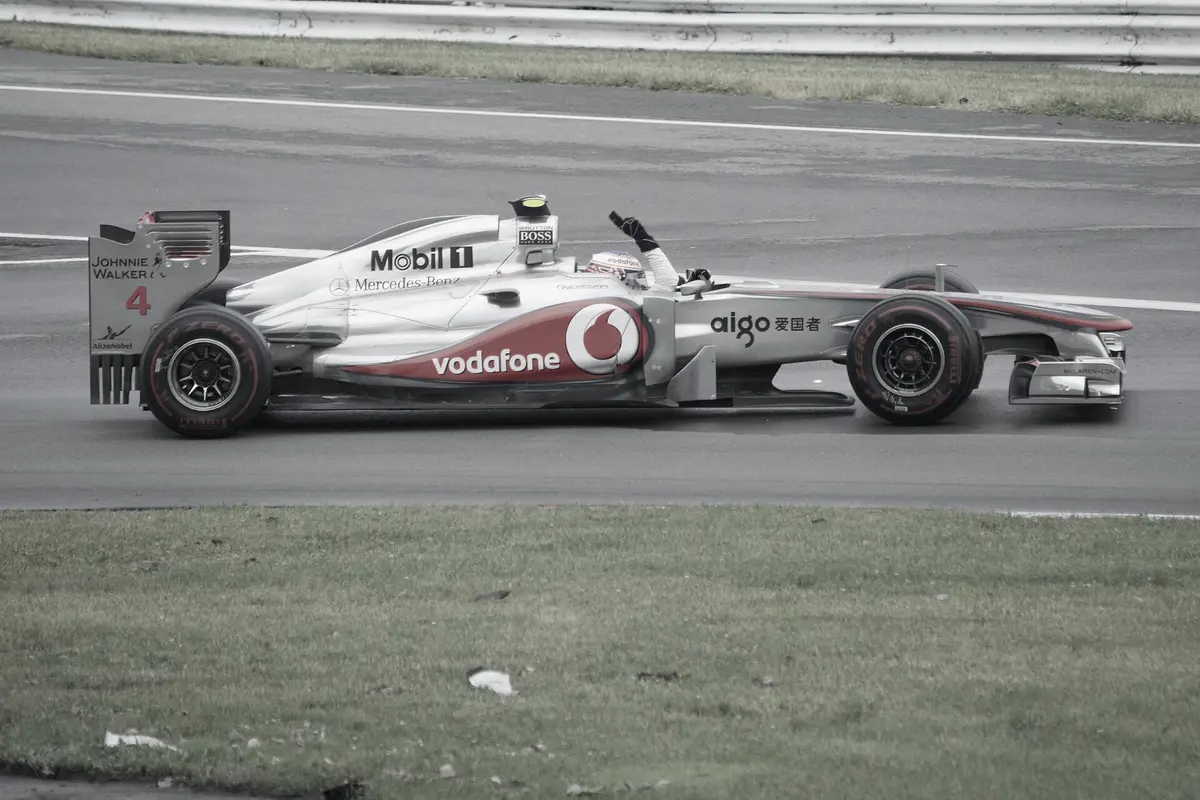
Jenson Button, McLaren, at the end of the 2011 Canadian Grand Prix.
Photo: Mark McArdle from Canada, CC BY-SA 2.0, via Wikimedia Commons; colour-graded and cropped by The Second Grid (this adaptation is licensed under the same licence).
How a 70-lap race took 4 hours
The rain was so heavy at the 13:00 start that the race began behind the Safety Car, with no formation lap (Formula1.com). The first 24 laps took the leader, Sebastian Vettel, 45 minutes, and the Safety Car was out 3 times in that spell.
The race clock, from the start to the chequered flag. Lap 25, which contains the red flag, took the leader 2 hours, 5 minutes and 5 seconds to complete.
Source: Formula1.com race result; Jolpica-F1 lap times (Sebastian Vettel)
On lap 25 the race was red-flagged in a downpour and the cars were parked on the grid. The lap on which it was stopped took Vettel 2 hours, 5 minutes and 5 seconds to complete, by the lap-time data (Jolpica-F1). Reports at the time said “over two hours”; nobody published a figure in minutes.
The last 45 laps took about 1 hour and 15 minutes, with 3 more Safety Car periods. Formula1.com counts 6 in total, a record, and that count includes the restart behind the Safety Car after the red flag. Button’s official race time, red flag included, is 4:04:39.537 (Formula1.com result). Over 70 laps of the 4.361 km circuit, that works out at an average of just under 75 km/h.
Last place with 33 laps to go
Button started 7th, and his race kept going wrong. On lap 7 he collided with his McLaren team-mate Lewis Hamilton on the pit straight, which put Hamilton out. Then he was given a drive-through penalty for speeding behind the Safety Car, which he served on lap 13. That dropped him to 15th.
Jenson Button’s position at the end of each lap. He fell to 21st of the 21 cars still running after his collision with Fernando Alonso on lap 37, and took the lead halfway round the last lap.
Source: Jolpica-F1 lap-by-lap positions, 2011 Canadian Grand Prix
He restarted 10th after the red flag, and was 11th when he and Fernando Alonso touched at Turn 3 on lap 37. Alonso’s Ferrari was out. Button had a puncture, made his 4th stop, and came back out 21st of the 21 cars still running. There were 33 laps left.
Once the track dried, he came through quickly: 14th by lap 44, 8th by lap 50, 4th by lap 55. After the last Safety Car period he passed Mark Webber at the final chicane on lap 64, and Michael Schumacher a lap later. On lap 69 he set the fastest lap of the race, a 1:16.956.
Vettel had led every lap. On the last one he was, in his words, “a little bit late on the brakes” at Turn 6, put a wheel on the wet part of the track and slid wide. Button went through and won by 2.709 seconds. “The last lap is the important one to be leading and I was leading half of it,” he said afterwards (FIA press conference).
Six trips down the pit lane
Button went down the pit lane 6 times: 5 stops for tyres and 1 for the penalty. Formula1.com called his lap-51 switch to slicks his “sixth pit lane visit of the day”. He spent about 2 minutes and 21 seconds in the pit lane altogether, by the timing data.
Jenson Button’s pit lane visits
| Lap | Visit | Time in pit lane |
|---|---|---|
| 8 | Stop 1, under the Safety Car | 23.650 s |
| 13 | Drive-through, speeding behind the Safety Car | 14.501 s |
| 19 | Stop 2, as the rain returned | 23.868 s |
| 35 | Stop 3, to intermediates | 23.589 s |
| 37 | Stop 4, puncture after contact with Alonso | 31.718 s |
| 51 | Stop 5, to slicks | 23.741 s |
Source: Jolpica-F1 pit stop data; Formula1.com
The stops followed the weather. He came in under the first Safety Car, again when the rain returned on lap 19, for intermediates on lap 35, for the puncture on lap 37, and for slicks on lap 51. “It felt like I spent more time in the pits than on the pit-straights,” Button said.
Why it can’t happen in 2026
The race changed the rules. From 2012, a race that was suspended could last no more than 4 hours in total (RaceFans). From 2021 the cap was cut to 3 hours (Motorsport Week).
Maximum length of a Grand Prix, 2026
3 hours
2 hours of racing, plus the length of any suspension, up to 3 hours in all. From 2027 a cut-off time of day, set for each race, replaces the 3-hour cap.
Source: FIA 2026 F1 Regulations, Section B (Sporting), Issue 09, Article B2.5.3 and Appendix B5
The 2026 wording is in Article B2.5.3 of the Sporting Regulations. If 2 hours pass before the race distance is complete, the leader takes the chequered flag at the end of the following lap. If the race is suspended, the length of the suspension is added to those 2 hours “up to a maximum total Race duration of three (3) hours” (FIA Sporting Regulations, Issue 09). Canada 2011 would have been over about an hour before Button crossed the line.
A cap brings its own problem. A wet race can run out of time with almost no racing in it, as Spa did in 2021.
It changes again next year. The same rulebook’s list of changes for 2027 deletes the 3-hour clause. In its place is a “Race Session Cut-Off Time”, a time of day set for each event and written into its competition visa (FIA, Appendix B5; The Race). When it is reached, the leader takes the flag at the end of the following lap. The 2-hour limit on racing stays. Either way, nobody will sit through another 4-hour Grand Prix.
Questions people also ask
- How long was the red flag at the 2011 Canadian Grand Prix?
- More than 2 hours. No official figure in minutes was published. The lap on which the race was stopped, lap 25, took the leader 2 hours, 5 minutes and 5 seconds including the stoppage.
- How long can an F1 race last?
- Under the 2026 Sporting Regulations a race ends after 2 hours of running if the distance hasn’t been completed. Time spent under a red flag is added, up to a maximum of 3 hours in total. From 2027 the 3-hour cap is replaced by a cut-off time of day set for each race.
Key facts
| Race | 2011 Canadian Grand Prix, Circuit Gilles Villeneuve, June 12, 2011, 70 laps |
|---|---|
| Winner’s time | 4:04:39.537, Jenson Button (McLaren), by 2.709 s from Sebastian Vettel |
| Red flag | Lap 25, for more than 2 hours; the cars waited on the grid |
| Button’s low point | 21st of 21 running cars after lap 37, with 33 laps to go |
| Pit lane visits | 6 for Button: 5 stops and a drive-through penalty |
| Time limit today | 3 hours including stoppages (2026 Sporting Regulations, B2.5.3) |
Sources (10, 3 primary, marked ●)
- ● 2011 Canadian Grand Prix, race result, Formula1.com
- ● 2011 Canadian Grand Prix, post-race press conference (archived), FIA
- ● 2026 F1 Regulations, Section B (Sporting), Issue 09 (October 1, 2026), Article B2.5.3 and Appendix B5, FIA
- 2011 Canadian Grand Prix: results, lap times and pit stops, Jolpica-F1 (Ergast) API
- Canada 2011: torrential rain, a Safety Car record and Button’s charge (June 12, 2023), Formula1.com
- Button bounces back to snatch last-lap win in Canada (June 12, 2011), RaceFans
- Canadian GP 2011 race report, grandprix.com
- The 2012 rules changes at a glance (March 8, 2012), RaceFans
- 2021 race window cut from four to three hours (December 2020), Motorsport Week
- F1 approves plan for shorter grands prix in 2027 (September 21, 2026), The Race
Spotted an error? Email contact@thesecondgrid.com with your source. Confirmed fixes go on the corrections log.