What was the F-duct in F1, and how did it work?
The F-duct was a driver-operated air channel on McLaren’s 2010 car, the MP4-25. On the straights the driver covered a hole in the cockpit, at first with his knee, which sent air out of a slot in the rear wing and stalled it. The stalled wing made less drag, and the car gained up to about 10 km/h.
It raced for one season. Most of the grid copied it, the teams voted it out for 2011, and F1 replaced it with a regulated system worked by a button: DRS.
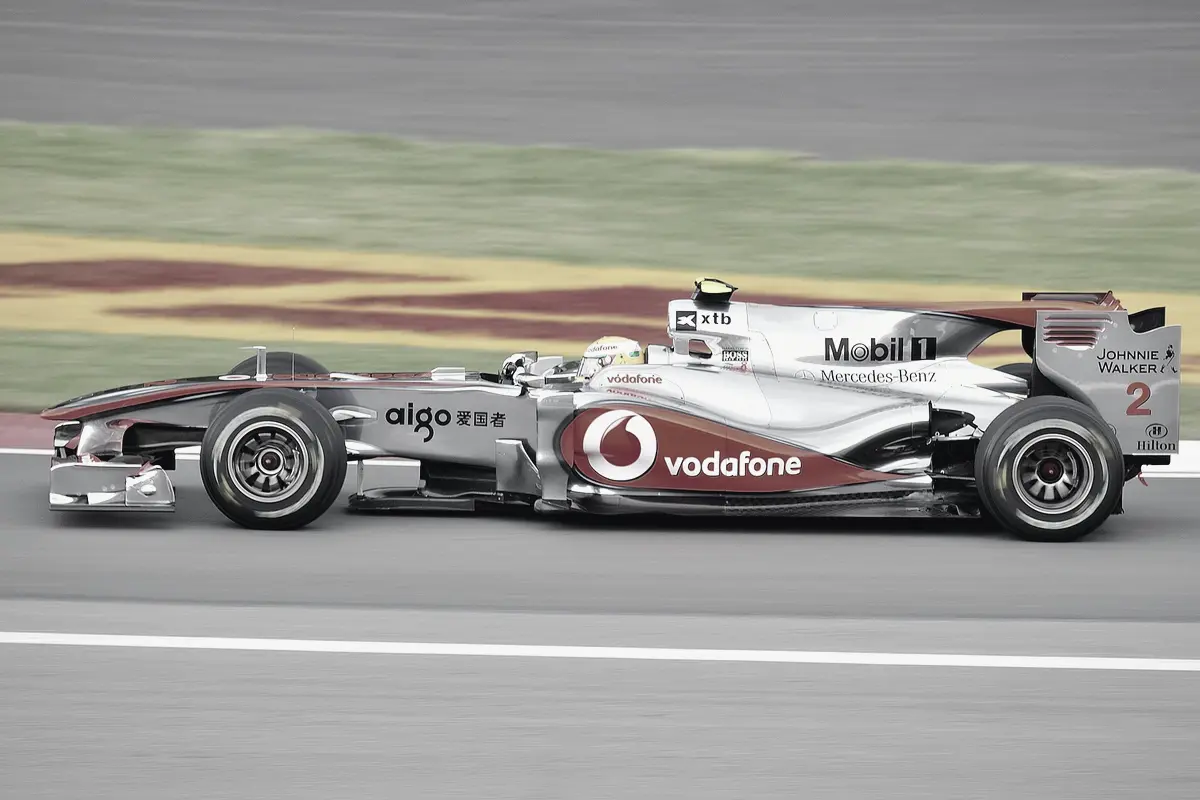
Lewis Hamilton, McLaren MP4-25, 2010 Canadian Grand Prix.
Photo: Gregory Moine, CC BY-SA 2.0, via Wikimedia Commons; colour-graded and cropped by The Second Grid (this adaptation is licensed under the same licence).
How the F-duct worked
McLaren’s project name was RW80. The press name came from the inlet’s position: a small scoop on top of the chassis, just ahead of the cockpit, sitting next to the “f” in the Vodafone logo (Autosport).
Simplified, not to scale. The snorkel air only flipped the switch; most of the air that stalled the wing came from the airbox, steered by a fluidic switch with no moving parts.
Source: Autosport technical analysis (Matt Somerfield, April 20, 2020); Motor Sport, May 2010
That scoop fed a duct running back through the monocoque to a hole inside the cockpit. With the hole open, the air simply vented into the cockpit and did nothing. With the hole covered, the same small flow was forced down a signal pipe to a fluidic switch at the back of the car, a piece of ducting with no moving parts.
The switch did the real work. It controlled a much larger flow taken in at the airbox above the driver’s head. Normally that air left harmlessly through an outlet in the engine cover. Once the switch flipped, it went up through the shark-fin engine cover into the hollow rear wing and out of a slot across it (Motor Sport).
That jet broke up the airflow on the wing’s underside, the surface that does most of the work, and the wing stalled. A stalled wing loses downforce, which a car doesn’t need on a straight, and drag, which was the point. Published estimates of the gain run from about 5 to 12 km/h depending on the track and the source; McLaren never gave a number. When the driver moved his leg for the braking zone, the flow reattached and the downforce came back for the corner.
Why it was legal
F1’s rules banned moveable aerodynamic devices, and they were written about bodywork. Nothing on the F-duct moved. The only moving part was the driver.
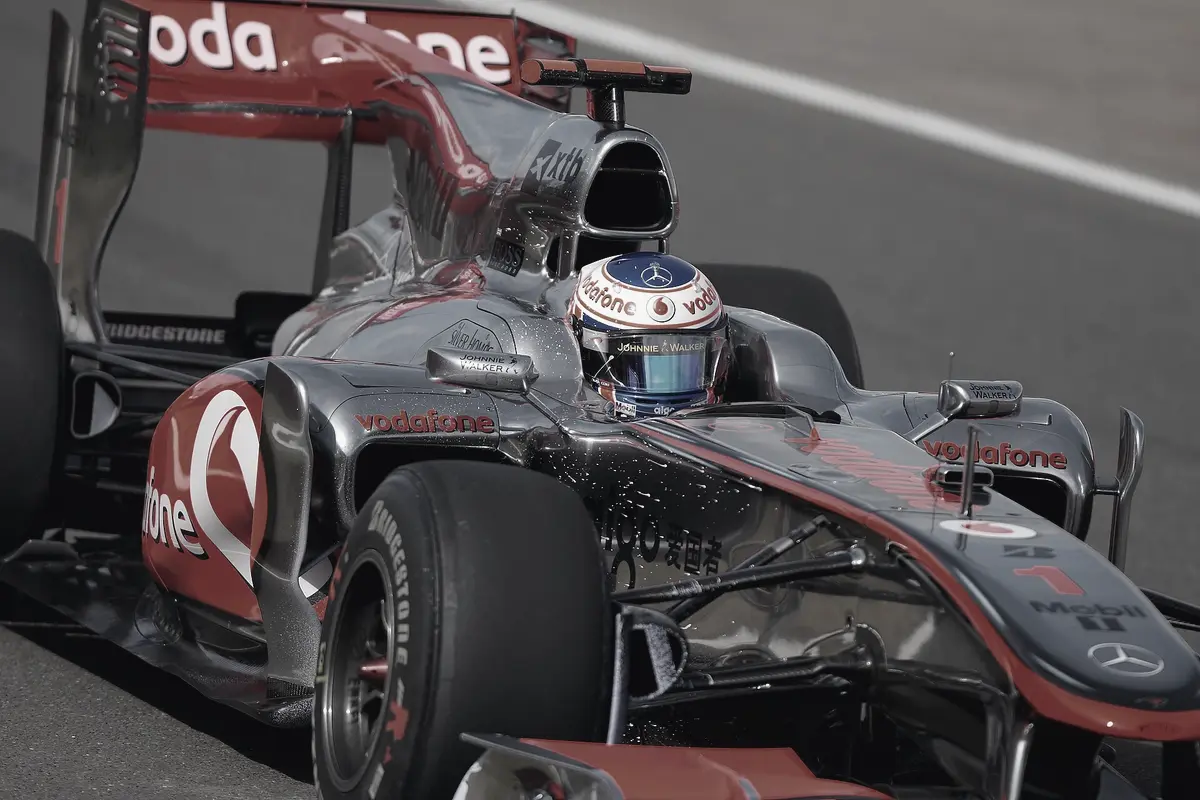
Jenson Button’s MP4-25 at the 2010 British Grand Prix. The F-duct inlet sits on top of the nose, next to the “f” of the Vodafone logo.
Photo: First Stop from UK, CC BY 2.0, via Wikimedia Commons; colour-graded and cropped by The Second Grid.
Rivals saw it in testing, worked out what it did and complained. The FIA accepted it at the first race of the season in Bahrain, on March 14, 2010. McLaren’s team principal Martin Whitmarsh told Motor Sport: “I’ve not heard an argument against it. People saying we’re not happy that someone’s got it is not good enough, really.”
McLaren kept refining it. A later version moved the pipework further into the cockpit so the drivers could cover the hole with an elbow, and from Japan the team moved the slot from the top flap to the main plane of the wing, as Force India had done.
Everyone copied it, and it was hard to copy
The catch for everyone else was the chassis. Monocoques are homologated by the FIA, so in theory teams could not drill new vent holes in them mid-season. Each copy had to find another way into the cockpit.
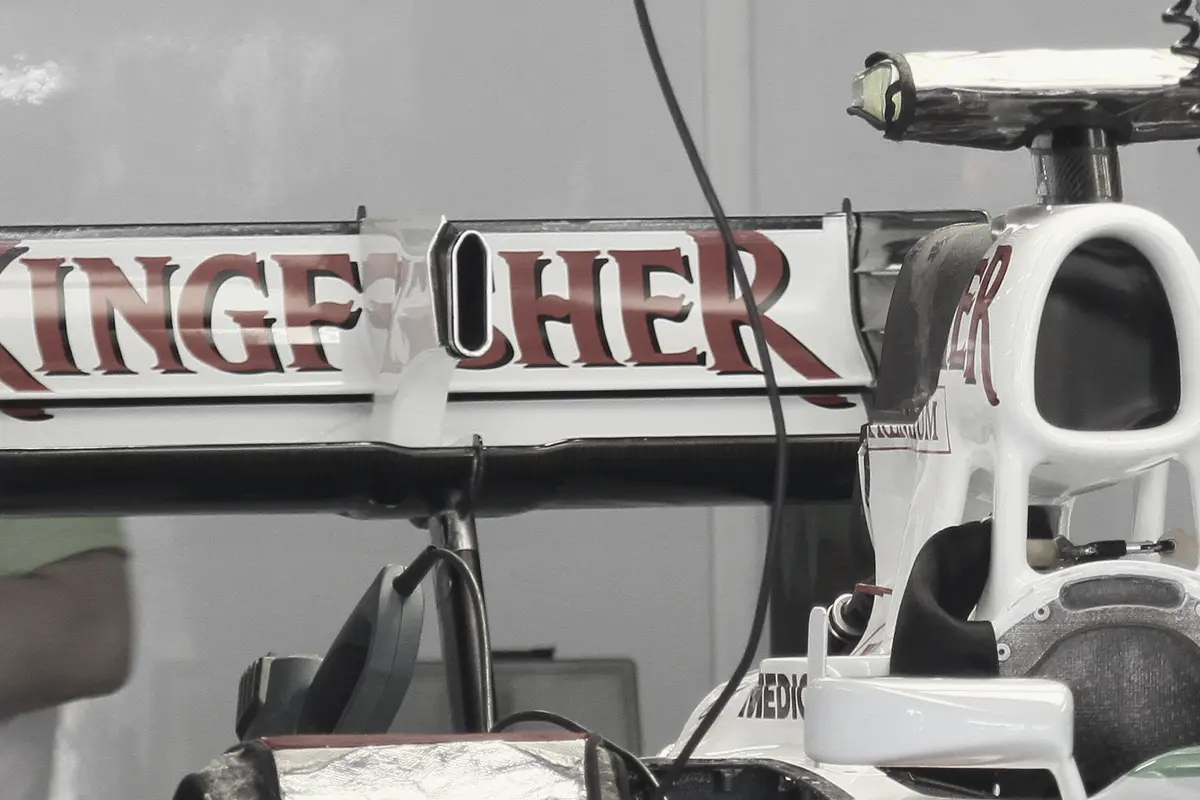
Force India’s VJM03 at the 2010 Japanese Grand Prix. The rounded slot in the middle of the rear wing is where the air came out.
Photo: Morio, CC BY-SA 3.0, via Wikimedia Commons; colour-graded and cropped by The Second Grid (this adaptation is licensed under the same licence).
Sauber had one by round 2 in Australia, with its inlet first mounted on a sidepod. Red Bull tested one in Turkey and raced it from Silverstone. Force India and Williams arrived in Valencia, and Renault only at Spa. Some versions needed the back of the driver’s hand rather than a leg, which meant steering one-handed down the straights.
That was the argument that killed it. On the morning of the Spanish Grand Prix, Sunday May 9, 2010, the teams’ association voted to ban F-ducts for 2011, on cost and safety grounds, against McLaren’s objections. Red Bull’s Christian Horner said some of the solutions looked “a bit marginal when you see drivers driving with finger tips and no hands” (Autosport).
The device didn’t decide the title either. McLaren won 5 races in 2010, and Red Bull, a late adopter, won both championships (Formula1.com).
From a knee to a button to Straight Mode
On June 23, 2010, the World Motor Sport Council made the ban law: “any car system, device or procedure which uses driver movement as a means of altering the aerodynamic characteristics of the car is prohibited from 2011”. At the same meeting it announced the replacement, an adjustable rear wing that could only be used after 2 laps, within 1 second of another car at set points, and that switched off the first time the driver braked (Autosport). That was DRS.
How F1 has cut drag on the straights
| Years | System | Who could use it | Moving parts |
|---|---|---|---|
| 2010 | F-duct | Any team that could build one | None: air did the switching |
| 2011–2025 | DRS | A car within 1 s of another at set points | A hydraulic rear-wing flap |
| 2026 | Straight Mode | Every car, in activation zones | Front and rear wing flaps |
Source: Autosport (June 23, 2010); FIA 2026 Formula 1 Technical Regulations, Section C
DRS lasted 15 seasons, from 2011 to 2025. The 2026 rules dropped it. Every car’s front and rear wing flaps now switch between Corner Mode and Straight Mode in designated zones, and the overtaking aid is Overtake Mode, extra electrical energy rather than a wing (The Race).
The 2010 clause survived all of it. Article C3.2.2 of the 2026 technical regulations still forbids any system that changes the car’s aerodynamics “through driver movement”, apart from the approved wing adjusters. F1 banned the idea, then sold a version of it back as a rule, which is a pattern it has repeated with cleverer cars than this one.
Questions people also ask
- What year was the F-duct used in F1?
- Only in 2010. McLaren raced it from the opening round in Bahrain, 7 rival teams had raced their own version by the end of the season, and it was banned from 2011.
- Is DRS the same as the F-duct?
- No. DRS opens a flap in the rear wing with a hydraulic actuator when the driver presses a button, under strict conditions. The F-duct had no moving parts: it used the driver’s body to redirect air and stall the wing. DRS was F1’s regulated replacement for it.
- Was the F-duct illegal?
- No. The FIA accepted it at the first race of 2010 and it raced all season. The teams then agreed to ban it from 2011, and the rule written against it is still in the 2026 regulations.
Key facts
| Car | McLaren MP4-25, 2010 (Jenson Button and Lewis Hamilton) |
|---|---|
| Name | Internal project RW80; “F” for the F in the Vodafone logo beside the inlet |
| Gain | Up to about 10 km/h on the straights (published estimates; McLaren gave no figure) |
| Cleared | Accepted by the FIA at the 2010 opener in Bahrain, March 14 |
| Banned | Teams voted on May 9, 2010; the World Motor Sport Council wrote it out from 2011 on June 23, 2010 |
| Replaced by | DRS, 2011–2025; in 2026, Straight Mode for every car |
Sources (10, 3 primary, marked ●)
- ● 2026 F1 Regulations, Section C (Technical), Issue 19 (C3.2.2, C3.10.10, C3.11.6), FIA
- ● 2010 race results, Formula1.com
- ● 2010 constructor standings, Formula1.com
- FIA announces moveable wing changes (World Motor Sport Council statement, June 23, 2010), Autosport
- Teams agree to ban F-ducts for 2011 (May 9, 2010), Autosport
- Banned: the 2010 Formula 1 season’s F-duct (Matt Somerfield, April 20, 2020), Autosport
- Teams likely to copy McLaren’s ‘F-duct’ (May 2010), Motor Sport
- New F1 2026 mode names and car images revealed (December 17, 2025), The Race
- Boost, overtake mode, active aero: key 2026 F1 terms explained (January 7, 2026), The Race
- McLaren MP4-25, Wikipedia
Spotted an error? Email contact@thesecondgrid.com with your source. Confirmed fixes go on the corrections log.
Related long-form episodes
All articles
Banned F1 cars that never cheated, ranked by how fast F1 killed them
Six Formula 1 cars were legal when they raced and banned anyway.

Why only 6 cars raced the 2005 US Grand Prix, and F1’s other worst rules
From Kyalami 1982 to Indianapolis 2005: 5 Formula 1 rule changes that backfired, ranked by what they cost before they were reversed.