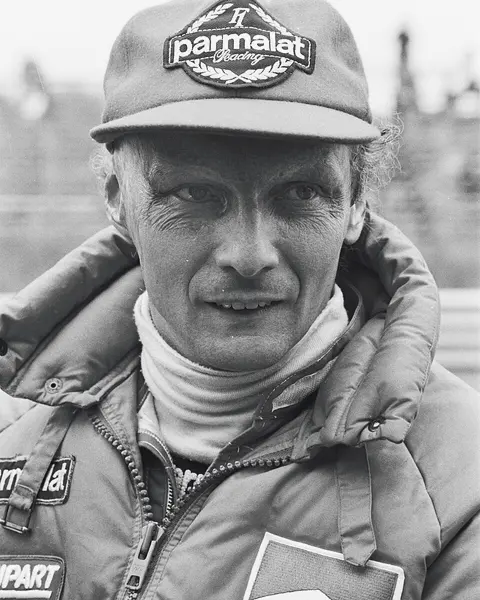
Niki Lauda, F1 world champion in 1975, 1977 and 1984
Niki Lauda, an Austrian driver, won the Formula 1 world championship three times, in 1975, 1977 and 1984, with Ferrari and McLaren. He won 25 of his 171 starts from 1971 to 1985.
- Titles
- 3
- Starts
- 171
- Wins
- 25
- Poles
- 24
- Podiums
- 54
Career 1971 to 1985, counted from Jolpica race results. How we count
Lauda’s three titles
| Year | Team | Pts | Runner-up |
|---|---|---|---|
| 1975 | Ferrari | 64.5 | Emerson Fittipaldi, 19.5 behind |
| 1977 | Ferrari | 70 | Jody Scheckter, 15 behind |
| 1984 | McLaren | 72 | Alain Prost, 0.5 behind |
Niki Lauda in short
Niki Lauda won 3 titles: 1975 and 1977 with Ferrari, and 1984 with McLaren. In 1984 he beat his team-mate Alain Prost by half a point, 72 to 71.5.
In 1976 he was badly burned when his Ferrari crashed and caught fire at the Nürburgring. He was racing again six weeks later at Monza, and lost the title to James Hunt by 1 point.
Lauda stopped racing in 1979, came back with McLaren in 1982, and retired for good after 1985. He won 25 Grands Prix.
Teams and career
- March1971, 1972, 13 starts
- BRM1973, 14 starts
- Ferrari1974 to 1977, 57 starts
- Brabham1978, 1979, 29 starts
- McLaren1982 to 1985, 58 starts
- First race
- 1971 Austrian Grand Prix
- Last race
- 1985 Australian Grand Prix
More on Lauda from us
How we count: starts leave out races where he did not take the start, and a shared car in the 1950s counts once. Poles are first place on the starting grid, as formula1.com counts them. Points are the ones that counted at the time (before 1991 only a driver’s best results counted). Published totals elsewhere can differ by one or two for the 1950s and 1960s.
Sources (5)
- Niki Lauda: race results by season, Jolpica F1 API
- 1975 drivers’ standings, Jolpica F1 API
- 1977 drivers’ standings, Jolpica F1 API
- 1984 drivers’ standings, Jolpica F1 API
- Niki Lauda, Wikipedia