What was Renault’s mass damper, and why did F1 ban it?
Renault’s mass damper was a weight on springs hidden inside the nose of its 2005 and 2006 cars. It moved against the car’s bounce, keeping the front steadier over bumps and kerbs. In July 2006 the FIA declared it an illegal aerodynamic device, lost to its own stewards, appealed, and the Court of Appeal banned it on August 22, 2006.
Fernando Alonso won the 2006 title anyway, by 13 points. The case is remembered less for the device than for the way it was banned: the FIA ended up in court arguing against the stewards it had appointed.
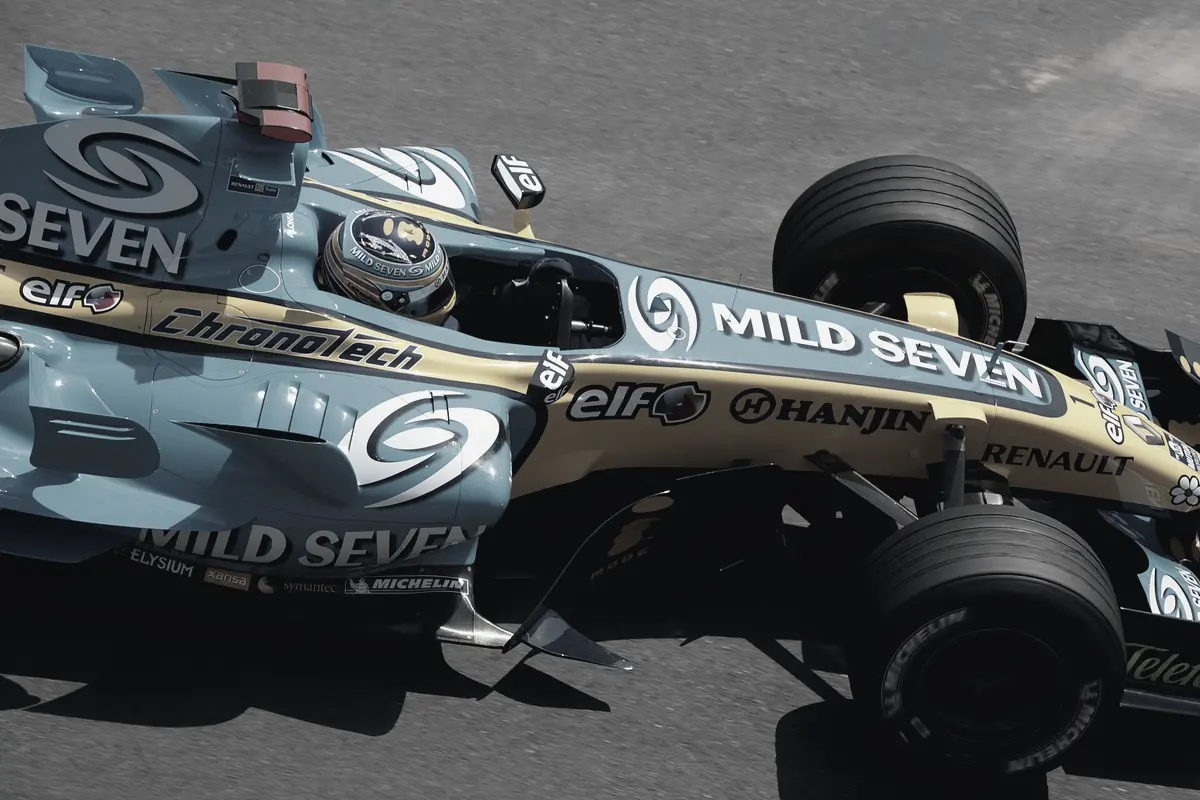
Fernando Alonso, Renault R26, 2006 Monaco Grand Prix.
Photo: Polmars, CC BY-SA 2.5, via Wikimedia Commons; colour-graded and cropped by The Second Grid (this adaptation is licensed under the same licence).
How a tuned mass damper works
A tuned mass damper is a weight held between springs and tuned to the frequency at which a structure tends to bounce. When the structure moves one way, the weight lags behind and pushes it back. Tall buildings use them against wind sway. Pat Symonds, Renault’s engineering director, traced the idea on cars back to a 1933 Alvis road car.
As the nose rises over a kerb, the sprung mass lags behind and pulls it back down, so the front of the car moves less and the front tyres and wing stay steadier.
Source: FIA International Court of Appeal judgment, August 22, 2006
Renault’s version sat in a casing fixed inside the nose. The FIA’s description, recorded in the Court of Appeal judgment, was “a mass of between 5 and 10 kilograms sprung by two springs suspended from the casing”, which reduced “compressions and travel when a car is driven over imperfections on a track”. The weight usually quoted in retellings, about 9 kg, fits inside that range but doesn’t appear in the official documents.
The benefit was in what stayed still. A front end that bounced less kept the front tyres in steadier contact with the track and the front wing at a steadier height. Autosport put a figure of about 0.3 seconds a lap to Symonds in 2006, and he answered: “Yes, that is a pretty average figure.” Nobody has measured it independently.
Legal for 10 months
Renault introduced the damper on the R25 in the autumn of 2005, reportedly at the Brazilian Grand Prix where Alonso clinched his first title, and carried it into 2006. It wasn’t secret, and it wasn’t unique. The Hockenheim stewards later noted that “some 7 teams have used a similar mass damper” (Autosport), Ferrari among them.

The nose of a Renault R26, the 2006 championship car, at the Museo Fernando Alonso. The damper sat inside the nose, out of sight.
Photo: Morio, CC BY-SA 4.0, via Wikimedia Commons; colour-graded and cropped by The Second Grid (this adaptation is licensed under the same licence).
In mid-July 2006 the FIA’s technical department changed its mind. Its memo said that until then “the view was held that the widespread use of mass dampers … did not contravene the F1 Technical Regulations”, and cited “an escalation in development of mass dampers by some teams” (Pitpass). Who pushed for the change is still disputed. Autosport reported in 2006 that McLaren had been lobbying the FIA; The Race wrote in 2021 that Ferrari had.
The FIA against its own stewards
The question reached the stewards at the German Grand Prix, in a case about Renault’s spare car. On July 28 they ruled, in Decision N°8, that “the use of such mass dampers must be considered as permissible.” The FIA appealed. To avoid having points taken away later, Renault raced at Hockenheim and in Hungary without it (grandprix.com).
Summer 2006, from memo to ban
| Date | What happened |
|---|---|
| Mid-July | FIA technical department tells teams mass dampers are now illegal |
| Jul 28 | Hockenheim stewards rule their use “permissible”; the FIA appeals |
| Jul 30, Aug 6 | Renault races Germany and Hungary without the damper |
| Aug 22 | Court of Appeal quashes the stewards: an infringement of Article 3.15 |
Source: FIA International Court of Appeal judgment; Autosport; grandprix.com
The hearing in Paris on August 22 turned on Article 3.15, which said any part influencing the car’s aerodynamics “must be rigidly secured to the entirely sprung part of the car (rigidly secured means not having any degree of freedom)”. Renault argued the damper existed to control vibration and gave only “a small, subsidiary aerodynamic advantage”. The court said that didn’t matter, “whatever the benefit may be”. Because the damper moved inside the bodywork and had an aerodynamic effect on the nose, it broke Article 3.15. The court also rejected the idea that it counted as suspension.
It added a pointed line for the future. Renault could have asked the FIA for an official clarification under Article 2.4 before racing it, “which was not the case”. Flavio Briatore saw it differently: “The races are being decided by the referee and not the players” (Autosport).
Did the ban cost Alonso the title?
No. Alonso’s lead over Michael Schumacher was already shrinking while Renault still had the damper, from 25 points after Canada to 17 after France (Formula1.com). It fell to 11 after Germany, and the two were level on 116 points after China. Schumacher’s engine failed in Japan, Alonso won there, and he finished the season on 134 points to Schumacher’s 121. Renault took the constructors’ title by 206 to 201.
Alonso’s points lead over Schumacher, 2006
Source: Formula1.com: Fernando Alonso and Michael Schumacher 2006 race results
Mass dampers are still banned: Article C10.2 of the 2026 Technical Regulations names them among the devices teams may not fit. The Renault case is the 4th of 6 in our piece on banned F1 cars that never cheated, where its clock reads 10 months.
Questions people also ask
- How heavy was Renault’s mass damper?
- The FIA described it at the Court of Appeal as “a mass of between 5 and 10 kilograms”. The figure of about 9 kg is widely repeated, but we have not found it in an official document.
- Are mass dampers legal in F1 now?
- No. Article C10.2 of the 2026 Technical Regulations still names mass dampers, along with inerters, among the devices teams may not fit.
Key facts
| What it was | A tuned mass damper: a weight between two springs in a casing inside the nose |
|---|---|
| Weight | “Between 5 and 10 kilograms”, in the FIA’s own description; often quoted as about 9 kg |
| Reported gain | About 0.3 s a lap, a figure Renault’s Pat Symonds called “pretty average” |
| Stewards’ ruling | July 28, 2006, Hockenheim: use “must be considered as permissible” |
| Banned | August 22, 2006, International Court of Appeal, under Article 3.15 |
| Title | Alonso still won: 134 points to Schumacher’s 121 |
Sources (12, 5 primary, marked ●)
- ● International Court of Appeal judgment: FIA v stewards’ Decision N°8, Renault F1 tuned mass damper (August 22, 2006), FIA
- ● Fernando Alonso, 2006 race results, Formula1.com
- ● Michael Schumacher, 2006 race results, Formula1.com
- ● 2006 constructor standings, Formula1.com
- ● 2026 F1 Regulations, Section C (Technical), Issue 20, FIA
- The full decision by the stewards (German GP, July 28, 2006), Autosport
- FIA bans controversial damper system (July 21, 2006), Pitpass
- Renault playing it safe, grandprix.com
- Mass distraction: interview with Pat Symonds (August 30, 2006), Autosport
- The critical mass (August 2, 2006), Autosport
- FIA rejects any Ferrari favouritism (August 5, 2006), Autosport
- The suspension trick that got the FIA to appeal against its stewards, The Race
Spotted an error? Email contact@thesecondgrid.com with your source. Confirmed fixes go on the corrections log.
Related long-form episodes
All articles
Banned F1 cars that never cheated, ranked by how fast F1 killed them
Six Formula 1 cars were legal when they raced and banned anyway.

Why only 6 cars raced the 2005 US Grand Prix, and F1’s other worst rules
From Kyalami 1982 to Indianapolis 2005: 5 Formula 1 rule changes that backfired, ranked by what they cost before they were reversed.