Why did F1 ban V10 engines?
F1 banned the V10 to cut power. In October 2004 the FIA said its 3.0-litre V10s were “approaching 1000 bhp”, against a promised maximum of 650, and imposed 2.4-litre V8s from 2006. It expected about 700 bhp. One team, Toro Rosso, was allowed to race a rev-limited V10 in 2006, and scored 1 point with it.
The sound, which is what most people now search for, was not part of the FIA’s case.
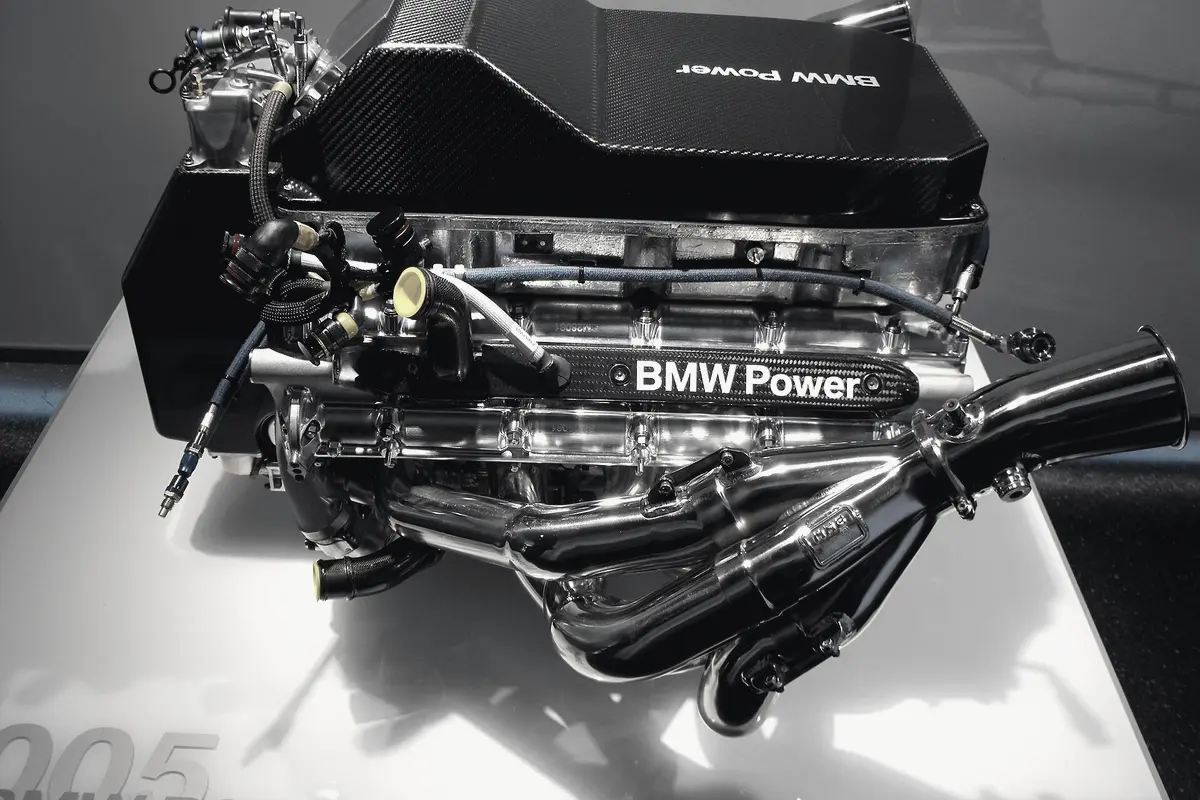
BMW P84/5, a 3.0-litre F1 V10 from 2005, at the BMW Museum.
Photo: Biser Todorov, CC BY 3.0, via Wikimedia Commons; colour-graded and cropped by The Second Grid.
The power problem
The 3.0-litre limit itself was a safety measure. After the fatal accidents at Imola in 1994, engines were cut from 3.5 litres to 3.0, and the FIA said the smaller engines would make at most 650 bhp.
Engine power, in the FIA’s own numbers (October 2004)
Source: FIA statement on the 2005 and 2006 regulations, October 22, 2004 (via Autosport / RaceCar.com)
Ten years later they were far past it. The FIA’s statement on October 22, 2004, put it plainly: “Current freedoms have resulted in engines approaching 1000 bhp compared to the absolute maximum of 650 bhp promised when engine capacity was reduced from 3.5 litres to 3.0 litres in 1994/5 following the Imola fatalities” (Autosport).
Its reason for the V8 was one line: “reducing capacity is a sure way to reduce power”. The new engine would also come with “a number of restrictions concerning design and permitted materials”, to slow the rate at which power crept back. The FIA estimated about 700 bhp, against the 1,000 it expected the V10s to reach by 2006.
How the V10 was voted out, without a vote
The teams never agreed to it. On June 30, 2004, the World Motor Sport Council invoked Article 7.5 of the Concorde Agreement, the contract between the FIA, the teams and the commercial rights holder. It gave the teams’ Technical Working Group 2 months to propose ways to slow the cars.
From notice to ban
| Date | What happened |
|---|---|
| Jun 30, 2004 | World Motor Sport Council invokes Article 7.5 of the Concorde Agreement: the teams have 2 months to propose cuts |
| Sep 6, 2004 | Teams vote 7–3 for the V8 package, short of the 8 votes needed |
| Oct 15, 2004 | Still no 8–2 majority for any package within the 45 days |
| Oct 21, 2004 | The WMSC imposes its own package, V8s included |
| Jan 1, 2006 | 2.4-litre V8 rules in force |
Source: FIA statement, October 22, 2004 (via RaceCar.com)
They missed the deadline, so the FIA’s technical department offered 3 packages, all including a 2.4-litre V8. On September 6 the teams voted 7–3 for the engine rules in Package 2, one vote short of the 8 they needed. By October 15 they still had no 8–2 majority for anything, and the 45 days the agreement allowed had run out.
That left the WMSC free to impose its own rules, and on October 21, 2004, it did (RaceCar.com). Package 2 cut downforce by an estimated 20% or more for 2005, made one set of tyres last qualifying and the race, and required engines to last 2 race weekends. The V8 followed on January 1, 2006.
The one team that kept a V10
The same statement carried an exception. “In order not to prejudice the smaller independent teams,” existing V10s could be used in 2006 and 2007 “subject to a restriction on revs”. The FIA’s reasoning was cost: a rev-limited V10 “can be adjusted to be competitive with factory 2.4 litre units, but will be far less costly”.
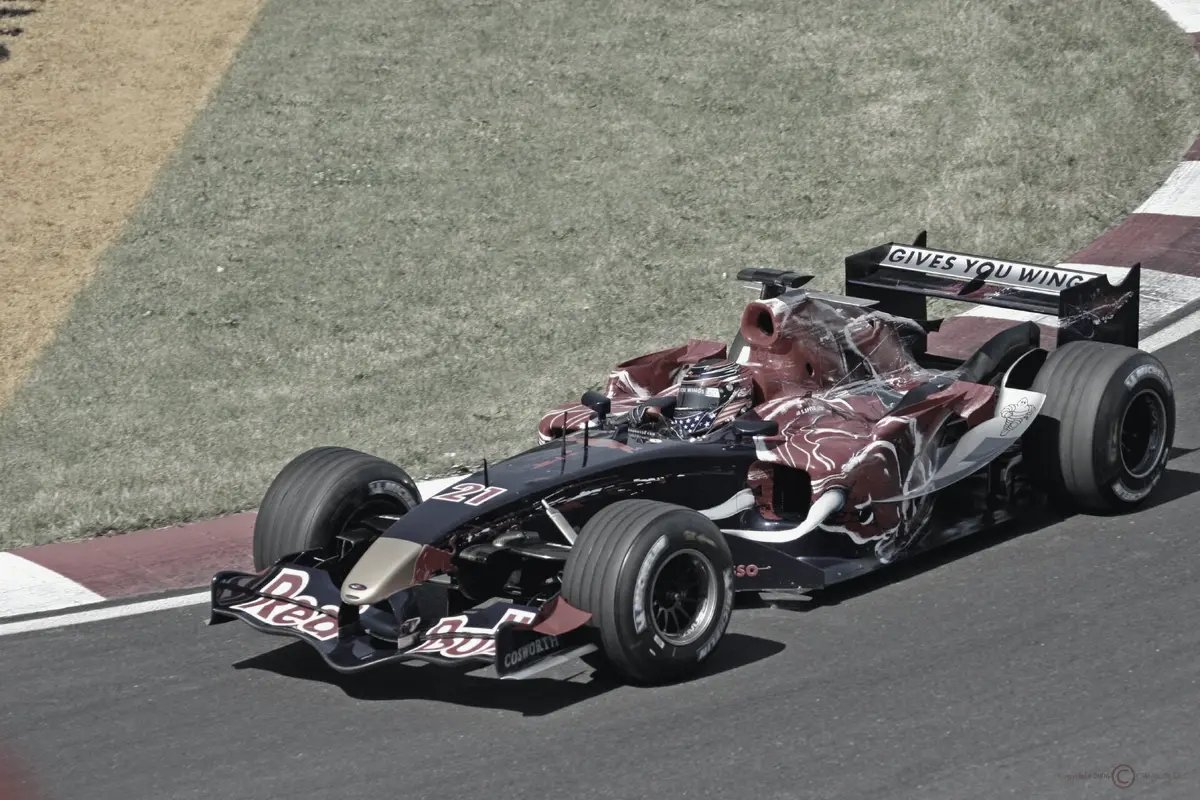
Scott Speed’s Toro Rosso STR1 at the 2006 Canadian Grand Prix. It was the last car to race a V10 in F1.
Photo: TMWolf, CC BY-SA 2.0, via Wikimedia Commons; colour-graded and cropped by The Second Grid (this adaptation is licensed under the same licence).
Only one team took it up. Toro Rosso, Red Bull’s second team and formerly Minardi, raced a Cosworth V10 in 2006, limited to 16,700 rpm and fitted with a 77 mm air restrictor.
Rivals were not convinced the sums worked. Autosport reported in December 2005 that the V10 was believed to be up to 80 bhp more powerful than the best V8s. Renault’s Pat Symonds said he had told the FIA’s Charlie Whiting that allowing cars “to run with a restrictor and high revs was in my mind illegal” (Autosport). After the Australian Grand Prix the teams at the back complained again. Grandprix.com’s view was that there were “no real signs that the V10s are quicker than the V8s” (grandprix.com).
What the exception was worth: 1 point
The results settled it. Toro Rosso scored 1 point all season, when Vitantonio Liuzzi finished 8th, a lap down, at Indianapolis on July 2, 2006 (Formula1.com). The team was 9th of 11 in the constructors’ championship, ahead of only MF1 and Super Aguri, who scored nothing.
1 point
Toro Rosso’s whole 2006 score with the rev-limited V10: Vitantonio Liuzzi, 8th at the United States Grand Prix on July 2, 2006.
Source: Formula1.com, 2006 United States Grand Prix result and 2006 constructor standings
The STR1’s last race, the Brazilian Grand Prix on October 22, 2006, was the last time a V10 raced in F1. Toro Rosso ran Ferrari V8s in 2007, and nobody used the second year of the concession.
The V8s themselves were tightly drawn: a 90-degree bank angle, a 98 mm maximum bore and a 95 kg minimum weight, among other limits. From 2007 their specification was frozen at the level of the 2006 Chinese Grand Prix and revs were capped at 19,000 rpm, to control costs and help engines last the weekend (The Race). F1 now tackles costs more directly, with a budget cap.
The wider trend never reversed. In 2014 F1 moved to 1.6-litre V6 turbo hybrids, and the 2026 power unit is still a 1.6-litre V6, now with about half its power from electricity. The FIA president said on October 13, 2026, that he wants a V8 on sustainable fuel from 2030 (Motorsport Week). The proposal on the table is a V8, not a V10.
Questions people also ask
- Did F1 ban the V10 because of the noise?
- No. The FIA’s stated reason in 2004 was power: the V10s were approaching 1,000 bhp. The rev-limited V10 that one team was allowed to keep was justified on cost.
- Will F1 bring back V10 engines?
- Not on current plans. As of October 2026 the engine the FIA president has described for 2030 is a V8 running on sustainable fuel, not a V10, and its regulations have not been published. The 2026 power unit is a 1.6-litre V6 turbo hybrid.
- What was the last F1 car with a V10?
- The Toro Rosso STR1, at the 2006 Brazilian Grand Prix on October 22, 2006. Toro Rosso switched to Ferrari V8s for 2007.
Key facts
| Decided | October 21, 2004, imposed by the FIA World Motor Sport Council |
|---|---|
| In force | January 1, 2006: 2.4-litre V8s replace 3.0-litre V10s |
| Stated reason | Power: V10s “approaching 1000 bhp”; the V8 was expected to make about 700 |
| The exception | Rev-limited V10s allowed for smaller teams in 2006–07; only Toro Rosso used one, in 2006 |
| The limits | 16,700 rpm and a 77 mm air restrictor (Cosworth V10, Toro Rosso STR1) |
| Last V10 race | 2006 Brazilian Grand Prix, October 22, 2006 |
Sources (11, 4 primary, marked ●)
- ● 2006 United States Grand Prix race result, Formula1.com
- ● 2006 Brazilian Grand Prix race result, Formula1.com
- ● 2006 constructor standings, Formula1.com
- ● 2007 constructor standings, Formula1.com
- FIA reveals 2005 regulations (FIA statement, October 22, 2004), Autosport / Atlas F1
- FIA F1 regulations confirmed (full FIA statement, October 23, 2004), RaceCar.com
- Teams still fear V10 advantage (December 3, 2005), Autosport
- The meaning of the word equivalency (April 5, 2006), grandprix.com
- Mark Hughes: lessons from F1’s last engine freeze (February 13, 2021), The Race
- FIA president drops major revelation for 2030 F1 regulations (October 13, 2026), Motorsport Week
- Toro Rosso STR1, Wikipedia
Spotted an error? Email contact@thesecondgrid.com with your source. Confirmed fixes go on the corrections log.