Why did F1 ban the V10? The real reason
The V10 wasn’t retired for its noise. In October 2004 the FIA killed it to slow the cars down, after the teams fell one vote short of agreeing. The V8 that replaced it ended up revving even higher, and more than twenty years later the FIA wants a loud engine back, mainly to save money. It’s a V8, not a V10.
By Jai ApexChecked against 45 sourcesUpdated
Listen to this article
15:11 narration
Or click any word in the article to start the narration from there.
Watch the video version (21:16)
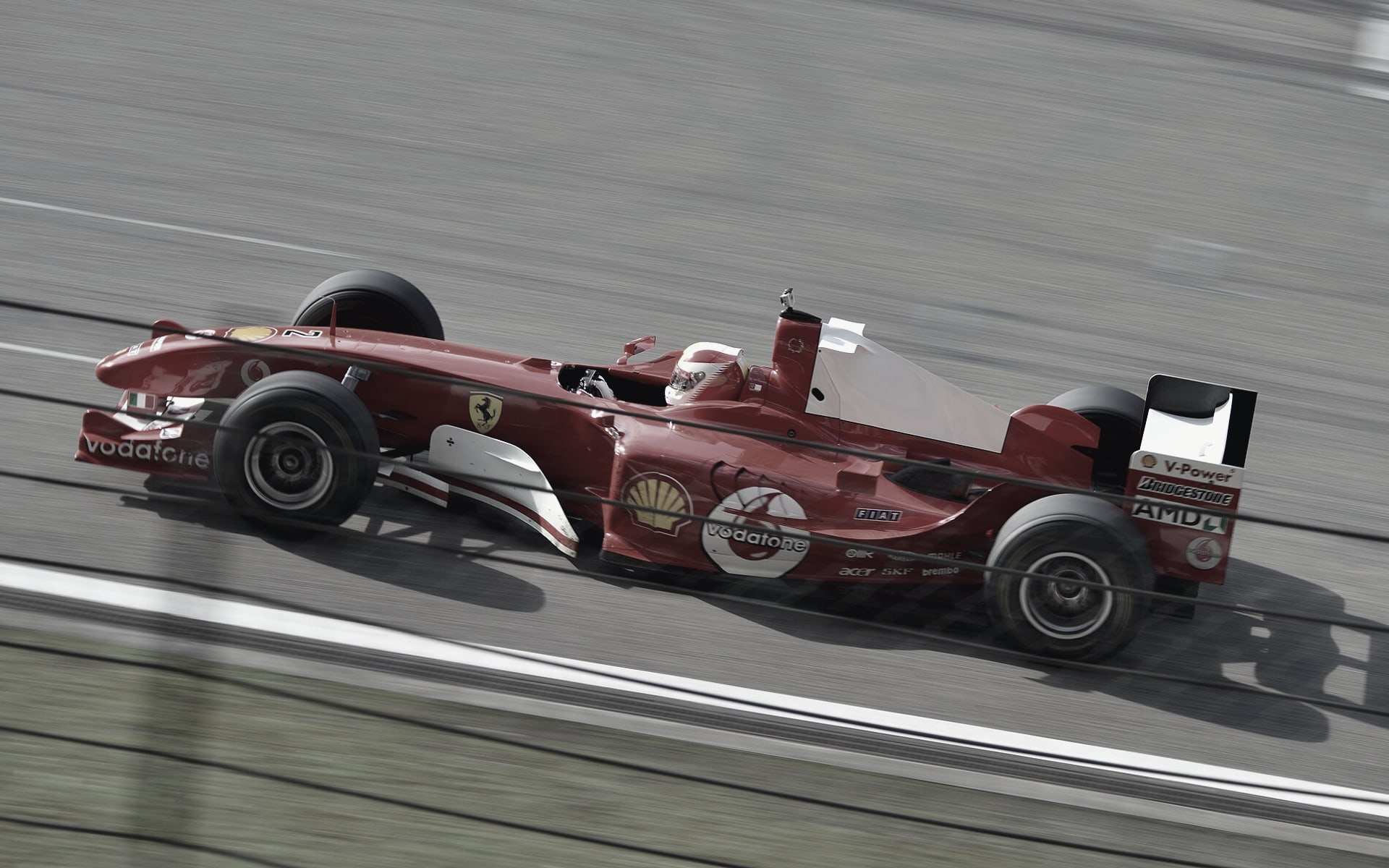
A Ferrari F2004, the V10 car from 2004, the year the FIA decided to replace the V10. Photo: emperornie, CC BY-SA 2.0, via Wikimedia Commons; colour-graded and cropped by The Second Grid; this adaptation is licensed CC BY-SA 2.0.
Ten cylinders at about 19,000 rpm: that is the sound F1 fans still go looking for, twenty years after it went quiet. It didn’t die of old age.
Imola 1994 and a promise of 650 horsepower
The story starts ten years earlier. Roland Ratzenberger and Ayrton Senna were both killed at Imola on the same weekend in 1994. Afterwards, the FIA cut engines from 3.5 litres to 3.0 for 1995. It later wrote that the smaller engines came with a promise: “an absolute maximum of 650 bhp”.
Engine power, in the FIA’s own numbers
Source: FIA statement, October 22, 2004 (via Autosport / Atlas F1 and RaceCar.com)
Teams ran all sorts of engines under the 3.0-litre rules at first: V8s, V10s and Ferrari’s V12. Ferrari raced its last V12 in 1995 and switched to a V10 for 1996. Soon every team had a V10, and for 2000 the rules capped engines at ten cylinders. That cap wasn’t a V10 mandate. Some makers were reportedly looking at V12s again to chase revs, and the rest agreed to a limit so nobody would be forced to build one.
Nineteen thousand revs, and where the sound comes from
If you can’t make an engine bigger, you make it spin faster. Each extra turn is another chance to burn fuel and air, so the whole field chased revs.
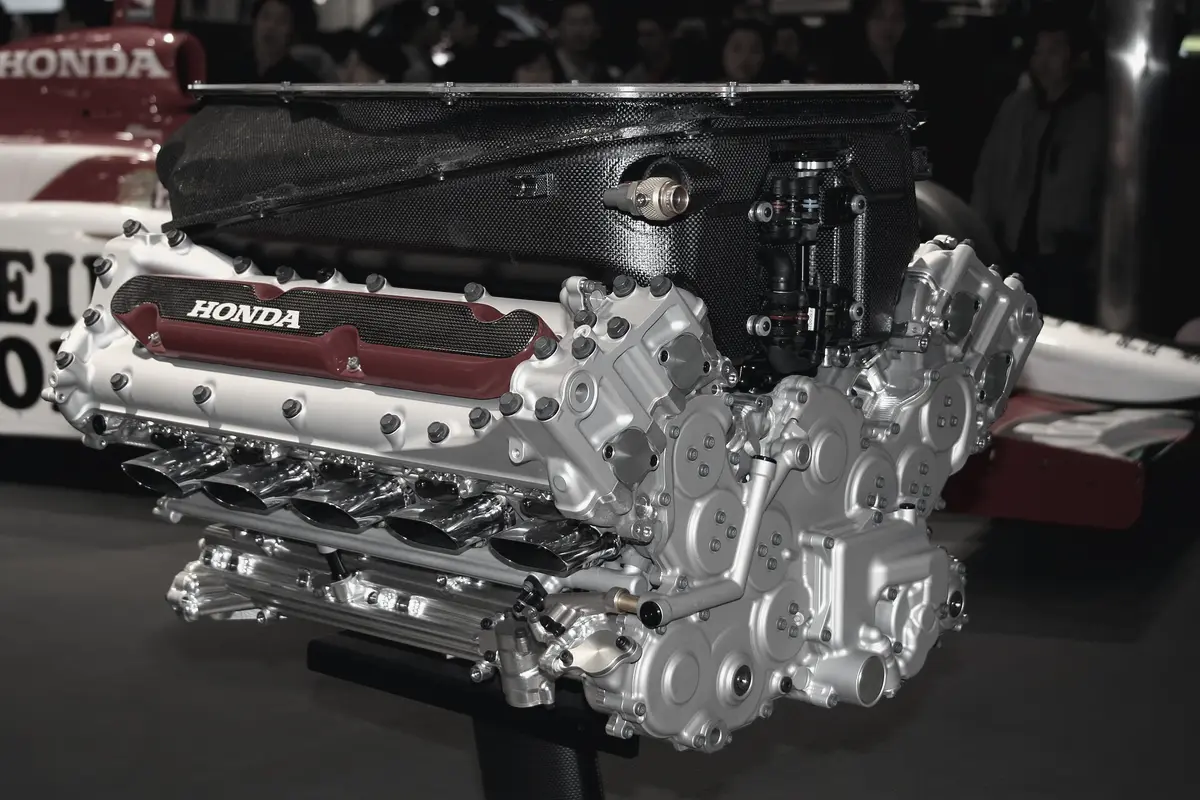
Honda’s RA005E, a 3.0-litre V10 from 2005, the last season every car on the grid had one.
Photo: machu., CC BY 2.0, via Wikimedia Commons; colour-graded and cropped by The Second Grid.
BMW got there first. In 2002 it was reported to be the first to take an F1 engine past 19,000 rpm, on its own dyno. A year later it was quoting a maximum of 19,200 rpm, a race limit of 19,000, and more than 900 bhp, from an engine weighing under 90 kg.
That rev figure is where the famous sound comes from. A four-stroke cylinder fires once every two turns of the crank. Ten cylinders at 19,000 rpm is 95,000 firings a minute, about 1,580 a second. At that rate you stop hearing separate bangs and hear one very high note. You’ll often see 20,000 rpm quoted for the V10s. Every figure we could source for a V10 sits around 19,000 to 19,250. The 20,000-plus numbers belong to the V8s that came next.
Power kept rising even as the rules tried to rein it in. Each engine had to last a whole race weekend in 2004 and two weekends in 2005, about 1,400 km. Teams didn’t publish power figures; when Ferrari launched its 2005 engine, it gave no number at all. The FIA had its own estimate, though. In October 2004 it said the engines were “approaching 1000 bhp”. That was against the promise of 650.
Six seconds a lap
What worried the FIA most was what all that power did to lap times. On June 30, 2004, its World Motor Sport Council met in Paris. Its statement said “speeds have increased very significantly over the last seven years”. It named two crashes from that season, Felipe Massa’s in Canada and Ralf Schumacher’s at Indianapolis, and said they had tested the limits of the safety measures. It also printed a table of the fastest practice laps at three circuits, six years apart.
The FIA’s lap-time table (fastest practice laps)
| Circuit | 1998 | 2004 | Faster by |
|---|---|---|---|
| Imola | 1:25.973 | 1:19.753 | 6.2 s |
| Monaco | 1:19.798 | 1:13.985 | 5.8 s |
| Melbourne | 1:30.010 | 1:24.408 | 5.6 s |
Source: World Motor Sport Council statement, June 30, 2004 (via RaceCar.com)
One vote short: Article 7.5 and the 7–3 vote
The man running the FIA was Max Mosley. In April 2004 his proposals had already included “a switch to 2.4-litre four-valve V8 engines”. In Paris the council reached for Article 7.5 of the Concorde Agreement. The council’s vote was unanimous. The teams’ Technical Working Group now had to propose ways to cut performance. If the teams couldn’t agree, the FIA could impose its own measures.
Not everyone liked where this was heading. BMW’s motorsport director, Mario Theissen, said in May that the V8 idea came up when technical directors were asked for a 700 hp engine, and that “at that time there was a discussion about safety and nothing else”. He also thought a V8 would be only slightly cheaper than a V10.
By September there were three packages on the table, and Mosley said all three meant 2.4-litre V8s for 2006. To adopt one, the teams needed eight votes out of ten. On September 6, 2004, they voted 7–3 for the engine rules in package 2. They were one vote short. The three who said no wanted to keep the 3.0-litre V10 for a couple more years, then perhaps move to a 2.7-litre V10. We couldn’t find a reliable record of which three teams they were, so we won’t guess.
Mosley left little doubt about who he thought he was up against. He said the car makers had been allowed “to spend huge sums of money on getting more horsepower”, and that he wouldn’t be swayed by “the threat of manufacturers leaving the sport”. The teams tried again on October 15 and still couldn’t agree.
October 21, 2004: the FIA decides
Six days later the World Council imposed its own package. From 2006 F1 would race 2.4-litre V8s, with limits on design and materials. The statement gave the reason in one line: “reducing capacity is a sure way to reduce power (as repeatedly requested by the TWG)”.
From warning to ban
| Date | What happened |
|---|---|
| Apr 23, 2004 | Max Mosley’s proposals include 2.4-litre V8s |
| Jun 30, 2004 | The World Council invokes Article 7.5 of the Concorde Agreement: the teams must propose ways to cut performance |
| Sep 6, 2004 | The teams vote 7–3 for the engine package. They needed 8 |
| Oct 15, 2004 | Still no 8–2 majority |
| Oct 21, 2004 | The World Council imposes its own package: 2.4-litre V8s from 2006 |
Source: FIA statements of June 30 and October 22, 2004; GrandPrix.com (April 23, 2004)
The FIA expected the V8s to make about 700 bhp, against the 1,000 it said the V10s would reach by 2006. It also said that “technical restrictions will limit the rate of power increase”. That was an admission of what everyone knew: give engineers a smaller engine and they start clawing the power back the next morning.
So who killed the V10? The FIA, through its World Council, with Mosley at the top.
The car makers think about court
BMW was, in Theissen’s words, “anything but happy”. A brand-new engine concept, with new chassis to match, would lead to “a cost escalation rather than a cost reduction”, he said.
Mercedes, BMW and Honda seriously considered a legal challenge. They argued that the Concorde Agreement promised stable engine rules to the end of 2007, and that changing them for 2006 broke that promise. In December they dropped it. Mercedes’ Norbert Haug explained why: their legal advice said the outcome “could have been quite promising for us… But we had to face a long time of judicial battles.” Our guess is that the calendar beat them. By the time a court ruled, they would have needed a V8 ready anyway.
Even Mosley didn’t think he had gone far enough. In February 2005 he was asked whether he had done enough to cut speeds, and said probably not, because going further would have met too much resistance. He was confident the V8s would slow the cars enough. Minardi’s owner, Paul Stoddart, had written to say the changes would be dangerous. Mosley brushed that aside.
The one team that kept a V10
Tucked into the October 2004 decision was a way out. Existing 3.0-litre V10s could still be used in 2006 and 2007, with a rev limit, because “we need an inexpensive but competitive engine for the smaller independent teams”. In the FIA’s own words, a rev-limited 3-litre “can be adjusted to be competitive with factory 2.4 litre units, but will be far less costly.”
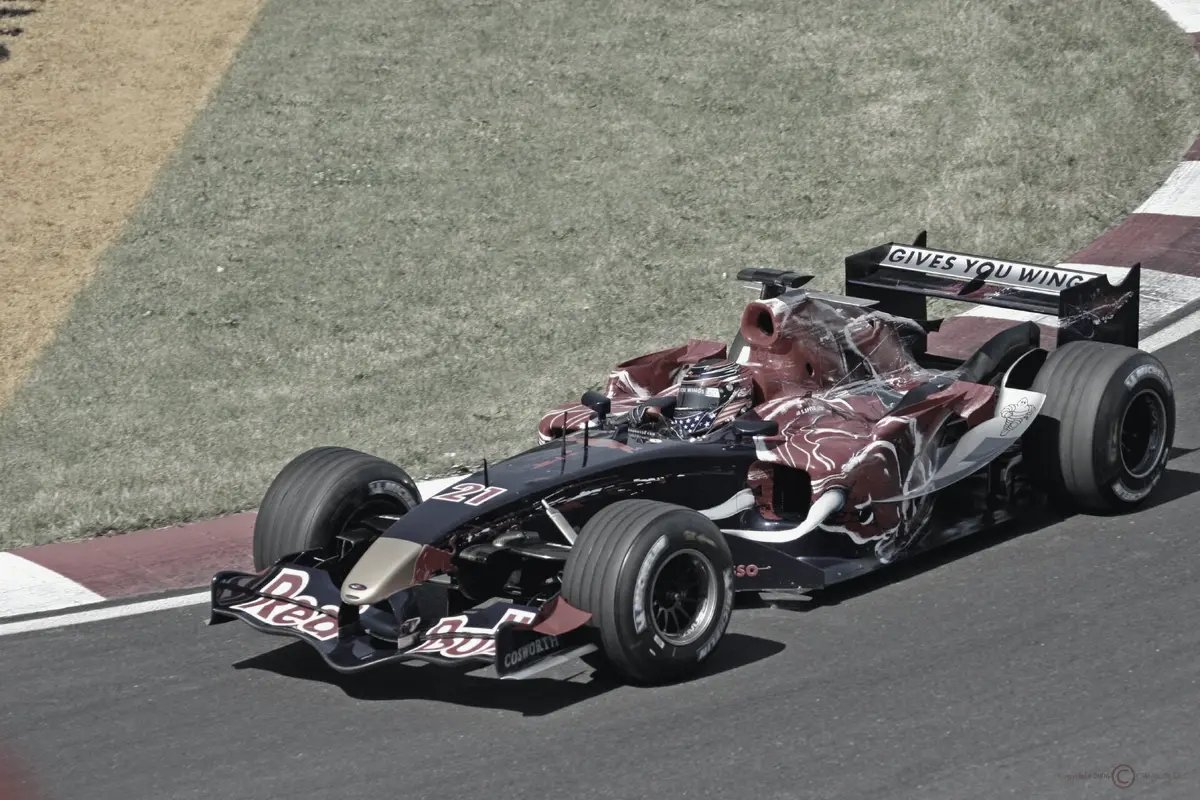
Scott Speed’s Toro Rosso STR1 at the 2006 Canadian Grand Prix. The STR1 was the last car to race a V10 in F1.
Photo: TMWolf, CC BY-SA 2.0, via Wikimedia Commons; colour-graded and cropped by The Second Grid (this adaptation is licensed under the same licence).
It was written for teams like Minardi, a small outfit running customer Cosworth V10s. Then Stoddart sold Minardi to Red Bull, which took control on November 1, 2005, and renamed it Toro Rosso. The team kept Minardi’s Cosworth V10 deal, so the escape route written for the small teams now belonged to Red Bull.
The Technical Working Group set the limits: a 77 mm air restrictor and a rev limit of 16,700 rpm. Rivals hated it. Renault’s Pat Symonds said “In retrospect we should not have done it because the team we were trying to protect is no longer here,” and asked what would stop Toyota “turning up at Monte Carlo with a V10 engine”. Midland’s Colin Kolles said the car was not legal and that “this engine does not belong in Formula One any more”. Cosworth, which built both engines, argued the restricted V10 should be comparable with a V8. The FIA said it wouldn’t change the limits until it had more data.
At the first race of 2006, in Bahrain, Haug said Toro Rosso had more horsepower, “up to 10 percent more”, and could challenge for a podium. By the Australian Grand Prix, Super Aguri and Midland had asked the FIA to keep Toro Rosso out of the constructors’ points. The funny part is that Red Bull’s owner didn’t even want the V10. In April Dietrich Mateschitz said: “I would rather today than tomorrow switch to a V8, but it is simply not possible.” The Cosworth contract ran to the end of 2007.
The feared V10 scored one point all season: Vitantonio Liuzzi, eighth at Indianapolis on July 2, 2006. The STR1’s last race was the Brazilian Grand Prix on October 22, 2006, the day of Michael Schumacher’s last race for Ferrari and Fernando Alonso’s second title. Almost nobody was watching the Toro Rosso, but that was the last time a V10 raced in Formula 1, two years and one day after the FIA decided to get rid of it. For 2007 Toro Rosso moved to a Ferrari V8.
The V8 revved higher than the V10 it replaced
The V8 was supposed to calm things down. It didn’t. Cosworth’s own figures for its 2006 V8 were 755 bhp at 19,250 rpm, more than the FIA’s estimate of 700 and about the same revs BMW’s V10 had been quoting in 2003. By the end of 2006, The Race’s Mark Hughes writes, the V8s could rev to around 21,000 rpm.
Rev limits and peaks, rpm
Source: BMW (September 22, 2003); Autosport (December 3, 2005); The Race (Mark Hughes, February 13, 2021); Cosworth CA2010 data via grandprixengines.co.uk; Autosport (June 30, 2011)
So the FIA stepped in again. For 2007 it capped revs at 19,000, the same figure BMW had used as its V10 race limit in 2003, and froze the engines. Teams could fix reliability, but they couldn’t chase power. From 2009 the cap came down to 18,000. If you ask us, that is the real end of the scream: not 2006, but the years of capped, frozen engines that followed.
2014: the quiet hybrids
On June 29, 2011, the FIA confirmed a 1.6-litre V6 turbo with energy recovery for 2014. It had first been planned as a four-cylinder engine for 2013, until the four engine manufacturers asked for a delay. The reasons this time were efficiency and “the clear need for the automotive industry to reduce emissions”. The rev limit was 15,000. The FIA even said the new engine would sound different.
It did. After the first race of 2014, the Australian Grand Prix chairman, Ron Walker, said “The sound is a disgrace”. Two months later Mercedes tried a trumpet-shaped exhaust at a Barcelona test. Nico Rosberg’s verdict: “It just didn’t work… It didn’t make it much louder.”
Why the FIA wants a loud engine again
In February 2025, after F1’s season launch in London, FIA president Mohammed Ben Sulayem wrote that F1 should consider “the roaring sound of the V10 running on sustainable fuel”. F1’s chief executive, Stefano Domenicali, had said something similar: maybe engines didn’t need to be “so complicated or so expensive”. Read the rest of Ben Sulayem’s post, though, and he also wrote about cost control on research spending. Cost has been the real argument ever since.
The idea of an early switch went nowhere at a meeting in Bahrain in April 2025. Ferrari and Red Bull were keen, but Audi and Honda had signed up for the 2026 hybrid rules and didn’t want a simple V10. By September 2025 the proposal had become a 2.4-litre V8 on sustainable fuel with a hybrid element, and a London meeting to push it was called off for lack of support. An early change needed four of the five manufacturers.
Then the 2026 cars arrived, with roughly half their power from the combustion engine and half from electric power, and drivers complained about lifting and coasting to recharge. In May 2026 F1 agreed to shift the split to 58/42 in 2027 and 60/40 in 2028. The change was confirmed in June, and the World Council ratified it on June 23.
In May, at the Miami Grand Prix, Ben Sulayem said “V8 is coming”. He’d like a V10 himself, he said, but a V10 isn’t feasible and a V8 is the practical choice. He is targeting 2030, and he said that in 2031 the FIA will have the power to act “without any votes from the PUMs”, the engine makers. It is the same move as 2004: ask the teams first, and if they won’t agree, use the rules to decide it yourself. Until then he needs four of the six manufacturers, including GM’s Cadillac, to say yes for 2030.
He repeated it in Rwanda on October 13, 2026: the new V8 will launch in 2030, with cars about 80 kg lighter and “at least 50 percent less in R&D and in the engine”. Audi’s Mattia Binotto, whose company had opposed an early switch, had said in September: “We know it’s a V8 for certain, 2030 the earliest introduction,” while adding that there was no clarity yet.
The 2030 V8: nothing voted yet
As of November 16, 2026, the day the video went out, there are reports that the FIA wants the framework signed off at a World Council meeting on December 10. Details such as a 3.0-litre turbo V8 have been reported but not confirmed.
Where the new engine stands (November 16, 2026)
| Decided | Nothing yet: no vote, no published 2030 rules |
| The plan | A V8 with a small electric part, on sustainable fuel |
| Target | 2030, which needs 4 of the 6 manufacturers |
| FIA alone | From 2031, the FIA says, without the manufacturers’ votes |
| V10 | Ruled out by the FIA president himself |
Source: Reuters and Autosport (May 4, 2026); PlanetF1 (September 25 and October 13, 2026); Yahoo Sports (October 14, 2026)
Right about the speed, wrong about the engine
Put the two decisions side by side. In 2004 the FIA killed a loud engine because the cars were too fast and chasing horsepower cost a fortune. Now it wants a loud V8 because the quiet engines got too complicated and too expensive.
Our view: the FIA was right about the speed. That lap-time table is hard to argue with. But we think it picked the wrong tool. For a whole season Toro Rosso raced a capped V10 against the V8s, and it didn’t run away with anything. The fix that kept the sound was in the FIA’s own rule book, and only one team ever used it.
Key facts
| Decided | October 21, 2004, imposed by the FIA World Motor Sport Council |
|---|---|
| Stated reason | “Reducing capacity is a sure way to reduce power”; the engines were “approaching 1000 bhp” |
| The trigger | Lap times about 6 seconds faster in 6 years at Imola, Monaco and Melbourne (1998–2004) |
| The vote | Teams voted 7–3 on September 6, 2004, one short of the 8 needed |
| The replacement | 2.4-litre V8 from 2006; about 21,000 rpm by the end of that year |
| Last V10 race in F1 | Toro Rosso STR1, Brazilian Grand Prix, October 22, 2006 |
| What’s planned now | A V8 targeted for 2030; not voted as of November 16, 2026. The FIA president has ruled out a V10 |
Video chapters
- 0:00The V10 didn’t die of old age
- 1:20Imola 1994 and the 650 hp promise
- 2:3419,000 rpm, and where the sound comes from
- 4:19Six seconds a lap: the FIA’s table
- 5:20Article 7.5 and the 7–3 vote
- 7:26October 21, 2004: the FIA decides
- 8:36The car makers think about court
- 10:31The loophole: one team keeps a V10
- 14:03The V8 revved even higher
- 15:092014: the quiet hybrids
- 16:252025–26: a loud engine again, but a V8
- 20:12Was it the right call?
The Short on this story
Sources (45)
- FIA reveals 2005 regulations (FIA statement, October 22, 2004), Autosport / Atlas F1
- FIA F1 regulations confirmed (FIA statement, October 23, 2004), RaceCar.com
- World Motorsport Council decisions (WMSC statement, July 1, 2004), RaceCar.com
- World Council backs Mosley (June 30, 2004), grandprix.com
- Mosley strikes (April 23, 2004), grandprix.com
- BMW expects V8 rethink (May 30, 2004), Autosport
- Mosley explains rules position (September 10, 2004), Autosport
- Theissen attacks new regs again (November 21, 2004), Autosport
- BMW, Honda drop opposition to engine changes (December 16, 2004), Autosport / Atlas F1
- Arbitration was right, says Merc (December 27, 2004), Autosport
- Mosley dismisses safety concerns (February 13, 2005), Autosport
- Formula 1 technical regulations for 2000 (Peter Wright, January 5, 2000), grandprix.com
- Ferrari 412 T2, Wikipedia
- Whispers from Munich (August 5, 2002), grandprix.com
- BMW Formula One engine development (P83 release, September 22, 2003), BMW Group
- Martinelli describes 055 engine (February 25, 2005), Autosport / Atlas F1
- 2005 RA005E, Honda
- Teams still fear V10 advantage (December 3, 2005), Autosport
- Kolles questions Toro Rosso V10 legality (February 3, 2006), Autosport
- Tech analysis: Scuderia Toro Rosso STR01 (February 22, 2006), Autosport
- Haug fears Toro Rosso can reach podium (March 9, 2006), Autosport
- Teams ask FIA to exclude STR (April 3, 2006), Autosport
- Toro Rosso plan to keep V10 in 2007 (April 11, 2006), Autosport
- Liuzzi welcomes first point for Toro Rosso (July 2, 2006), Autosport
- Scuderia Toro Rosso, Wikipedia
- Toro Rosso STR1, Wikipedia
- Toro Rosso STR2, Wikipedia
- Massa wins race, Alonso takes title (October 23, 2006), Al Jazeera
- Note 108: Cosworth 2006 Type CA (D. Taulbut, from Race Engine Technology), Grand Prix Engine Development
- Lessons from F1’s last engine freeze (Mark Hughes, February 13, 2021), The Race
- Engine makers and FIA agree on rules (October 1, 2006), Autosport
- Q&A: FIA on new engine regulations (June 30, 2011), Autosport
- F1 noise: Ron Walker on the 2014 Australian Grand Prix (March 25, 2014), HuffPost UK
- Megaphone exhaust didn’t work, says Rosberg (May 15, 2014), grandprix.com
- F1 mulling return of V10 roar with sustainable fuel, FIA chief says (February 21, 2025), ESPN (Reuters)
- Six things we’ve learned from F1’s V10 engine summit (April 11, 2025), The Race
- FIA’s V8 push in limbo as F1 engine summit called off (September 5, 2025), The Race
- F1 agrees plan to ditch ‘50/50’ engine power split for 2027 (May 8, 2026), The Race
- Formula 1 shift to more engine power, less electric for 2027 agreed (AP, June 10, 2026), WTOP
- F1 could return to V8 engines by 2030, says FIA boss (Reuters, May 4, 2026), TimesLIVE
- Why V8s have entered the F1 chat (again) (May 4, 2026), Autosport
- F1 2030 V8 engine: what we know (Thomas Maher, September 25, 2026), PlanetF1
- FIA confirms F1 V8 (October 13, 2026), PlanetF1
- FIA president confirms when V8 engines will make F1 return (October 13, 2026), RacingNews365
- Ben Sulayem puts F1’s V8 in 2030, a year before the FIA could impose it alone (October 14, 2026), Yahoo Sports
Spotted an error? Email contact@thesecondgrid.com with your source. Confirmed fixes go on the corrections log.
Related
More articles
- Banned F1 cars that never cheated, ranked by how fast F1 killed themRules & Tech
- Why only 6 cars raced the 2005 US Grand Prix, and F1’s other worst rulesRules & Tech
- Why F1 banned refuelling twice, and won’t bring it backHistory
Read next
All articles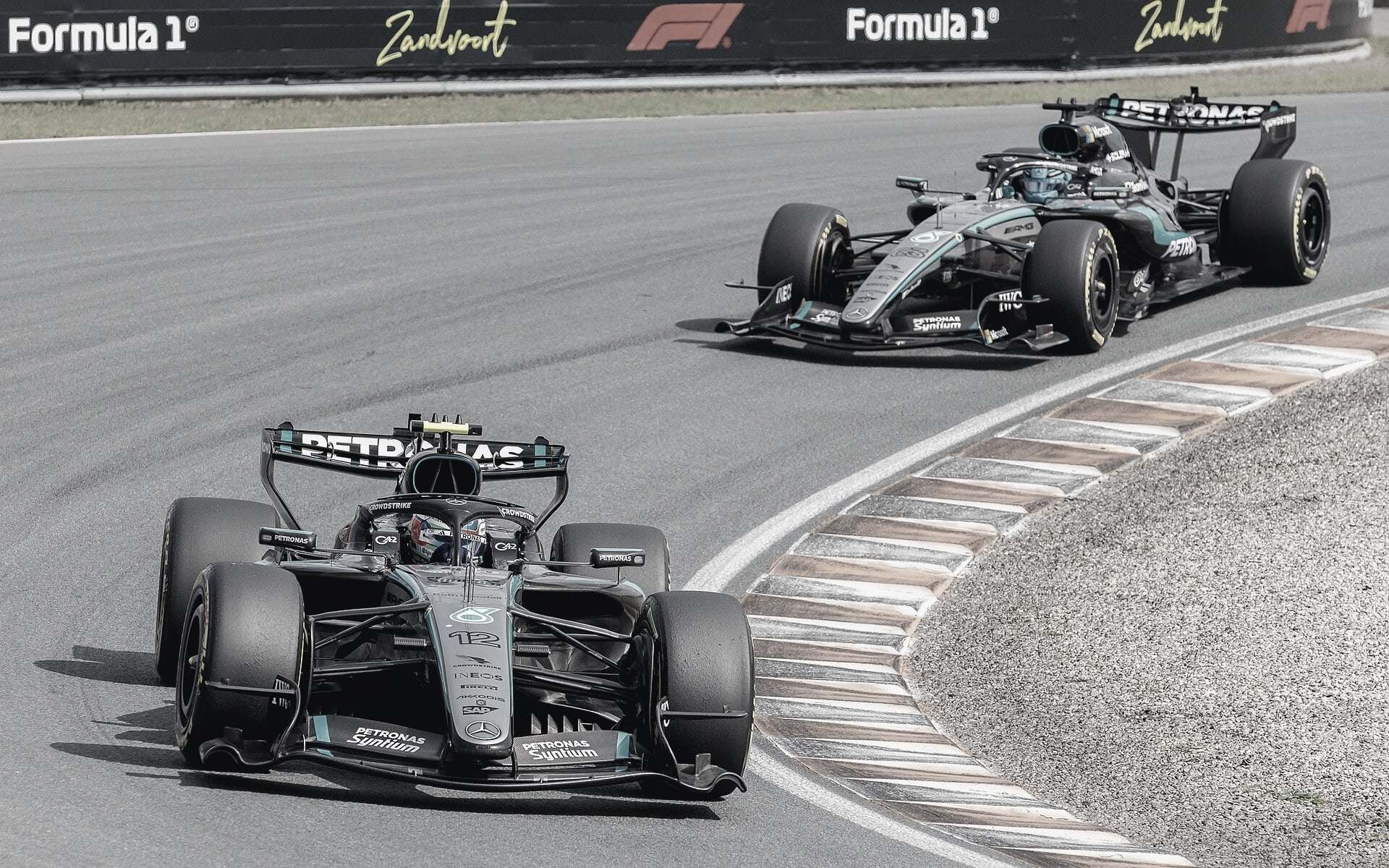
Was it the car or Kimi Antonelli?
Mercedes won 12 of the first 20 races of 2026, so it’s fair to ask how much of Kimi Antonelli’s title was the car.
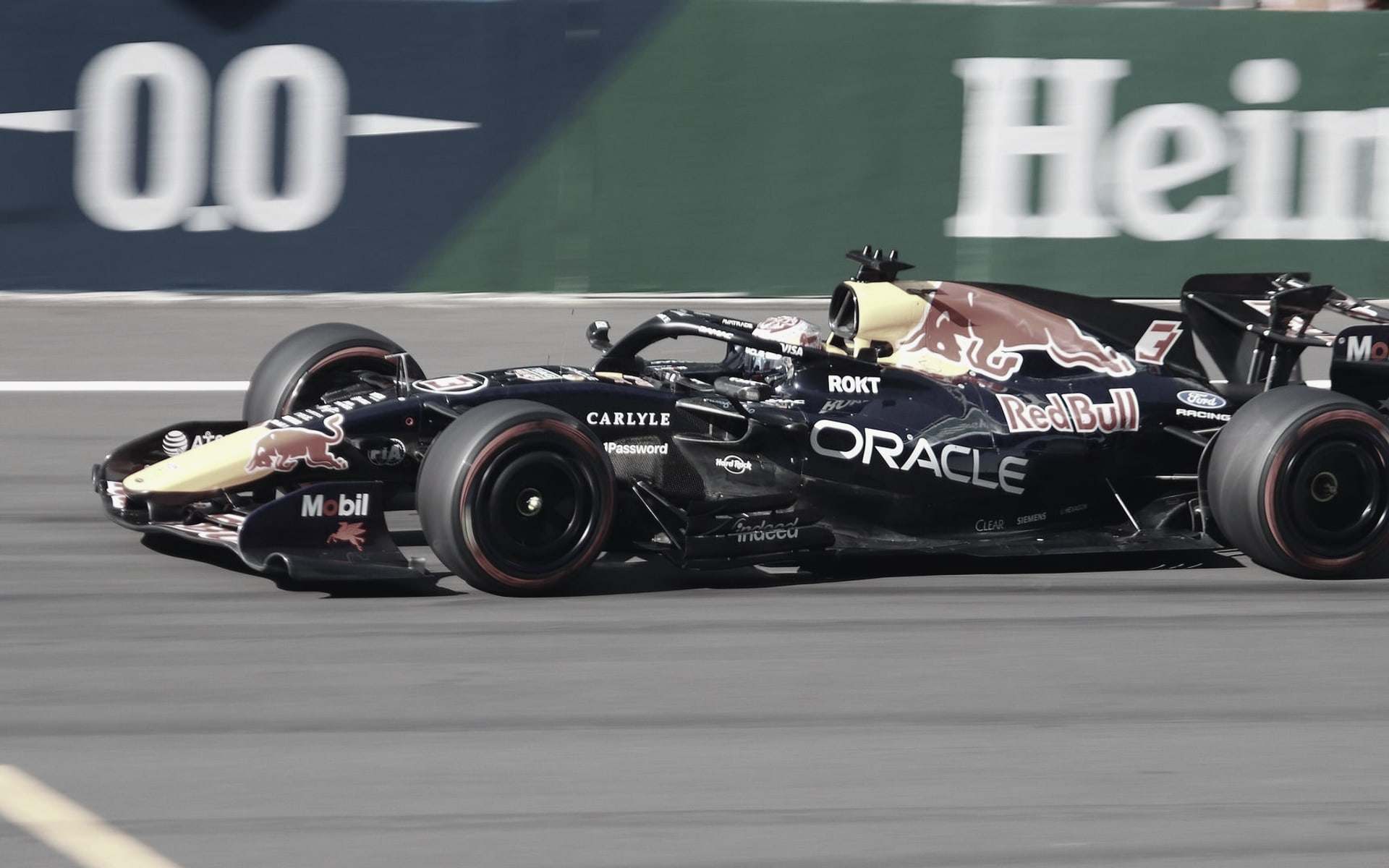
How Verstappen nearly won from the back: Brazil GP 2026 review
Max Verstappen started the São Paulo Grand Prix 21st and finished second, 14.6 seconds behind Lando Norris, who won from pole.
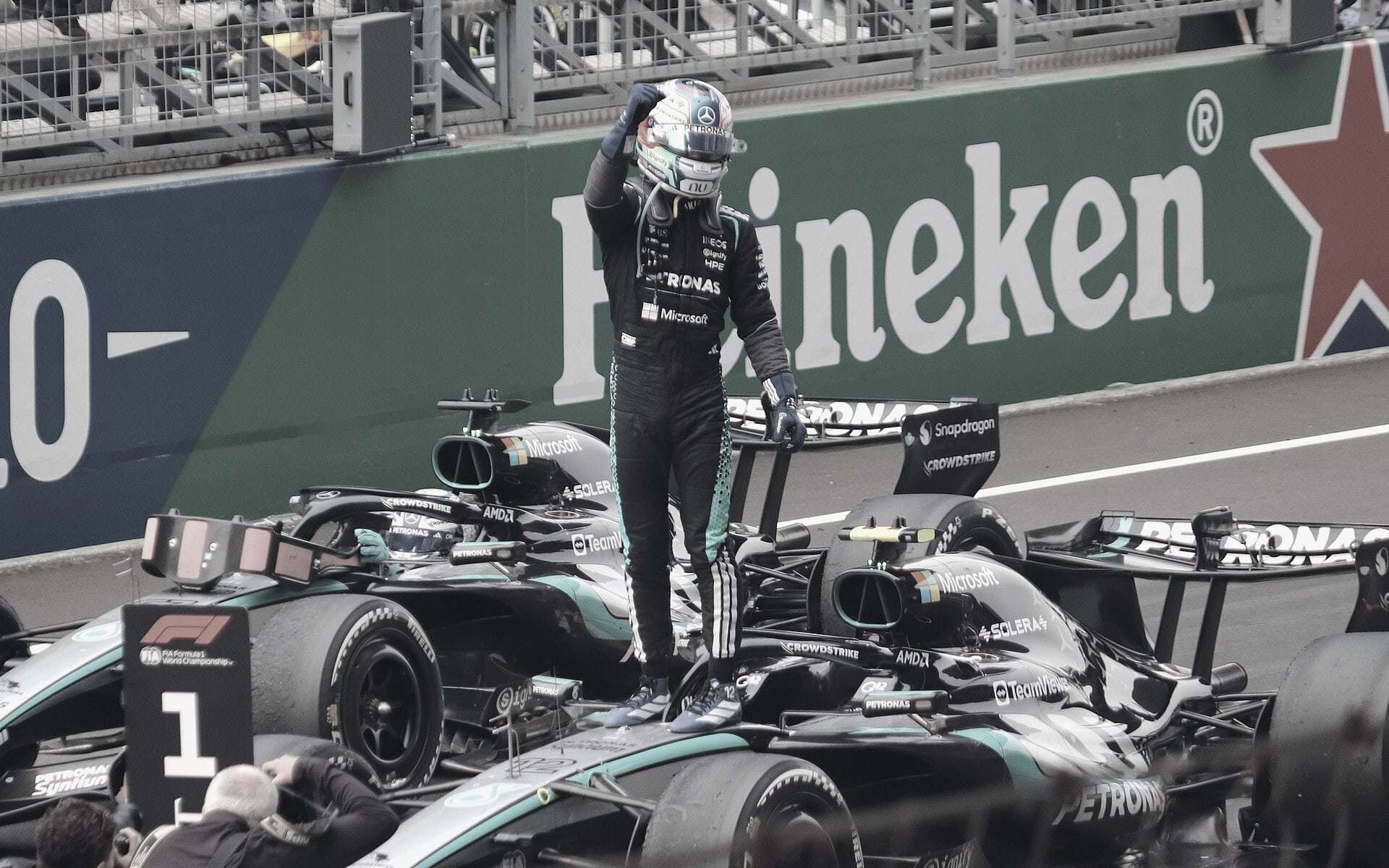
Mexico GP 2026 review: Antonelli is champion, Ferrari threw the win away
Max Verstappen won in Mexico City from fifth on the grid, 0.799 seconds ahead of Lewis Hamilton.