What is porpoising in F1?
Porpoising is an aerodynamic bounce at high speed. A ground-effect floor makes more downforce the closer it runs to the track, until the airflow underneath stalls. Downforce drops, the car rises, the flow recovers and the car is sucked back down, again and again along the straight.
It came back to F1 with the ground-effect cars of 2022, and the name comes from the way the cars rose and dipped down the straights, like a porpoise swimming at the surface.
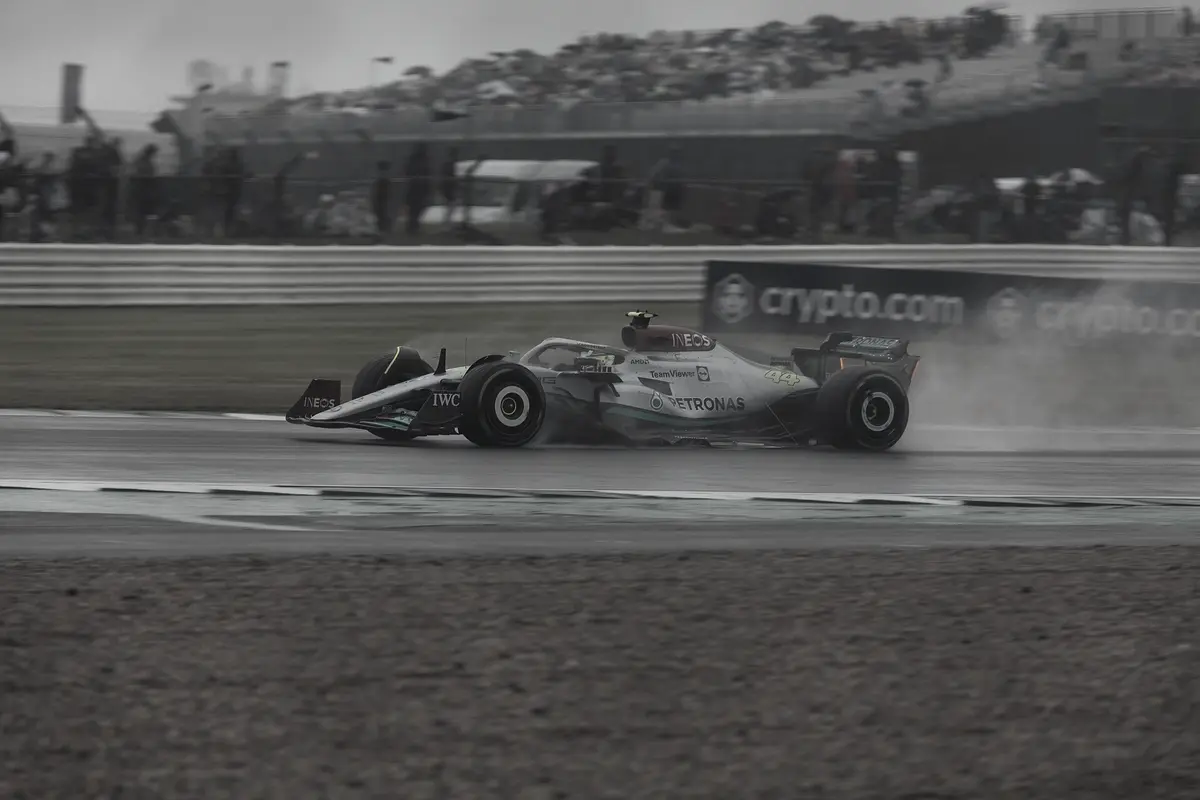
Lewis Hamilton, Mercedes W13, 2022 British Grand Prix weekend.
Photo: Chris Game, CC BY-SA 2.0, via Wikimedia Commons; colour-graded and cropped by The Second Grid (this adaptation is licensed under the same licence).
Why a ground-effect floor bounces: what causes porpoising
The 2022 rules moved most of a car’s downforce under the floor, into 2 large Venturi tunnels. Air speeds up through the narrow part of each tunnel, its pressure drops, and the low pressure pulls the car towards the track. Run the floor lower and the effect gets stronger, so teams ran their cars as low and stiff as they could.
The loop repeats along the straight for as long as the car stays above the speed where the floor stalls.
Source: The Race, “What is porpoising and why are 2022 F1 cars doing it?” (March 10, 2022)
There is a limit. The Race’s technical analysis in March 2022 described the 2022 diffuser as much wider than the 2021 one. Above a certain speed, on average about 155 mph (250 km/h), the air can no longer follow its walls. The flow separates from the upper edge of the diffuser, the floor stalls, and the flow through the tunnels slows (The Race).
With less downforce pushing on it, the suspension unloads and the car rises. The higher floor gives the air room to reattach, downforce comes back, and the car is pulled down to where it stalled in the first place. The loop runs for as long as the car is fast enough.
Using the air under a car to pull it to the track is an old idea in F1. In 1978 Brabham did it with a fan, and was told to stop within a week.
Porpoising or bouncing: what happened in Baku
The race most fans remember is the 2022 Azerbaijan Grand Prix on June 12. Lewis Hamilton finished 4th (Formula1.com) and said that by the end he was “just praying for it to end”, with his back in pain.
Two problems that look the same from outside
| Porpoising | Bouncing | |
|---|---|---|
| What drives it | Airflow under the floor stalling and recovering | A stiff, low car hitting the track |
| When it shows | At high speed, even on smooth track | On bumpy track; Baku was among the worst |
| What sets it off | Running the floor too close to the ground | The tarmac and the set-up |
Source: James Vowles (Mercedes), June 2022, via GPFans; The Race (March 2022)
It was called porpoising at the time. Mercedes said it wasn’t. Four days later its strategy director James Vowles explained that the team had made progress on porpoising, and that the fix had exposed “a second issue that was being masked by the first”. The car now ran lower, “hitting the deck quite hard”, and that was bouncing: “to the outside, it looks almost identical, but there is a subtle difference between the two” (GPFans).
Bouncing is a mechanical problem, not an aerodynamic one. A very stiff car run very low hits the track over every bump, and Vowles called it “a function of how smooth the tarmac is”, with Baku at the worst end and Barcelona at the best.
What the FIA did: a limit on the shaking
Before the Canadian Grand Prix in June 2022, the FIA issued a technical directive “in the interest of safety”. It cited drivers’ concentration at 300 km/h and “the immediate physical impact on the health of the drivers, a number of whom have reported back pain” (Motorsport Week).
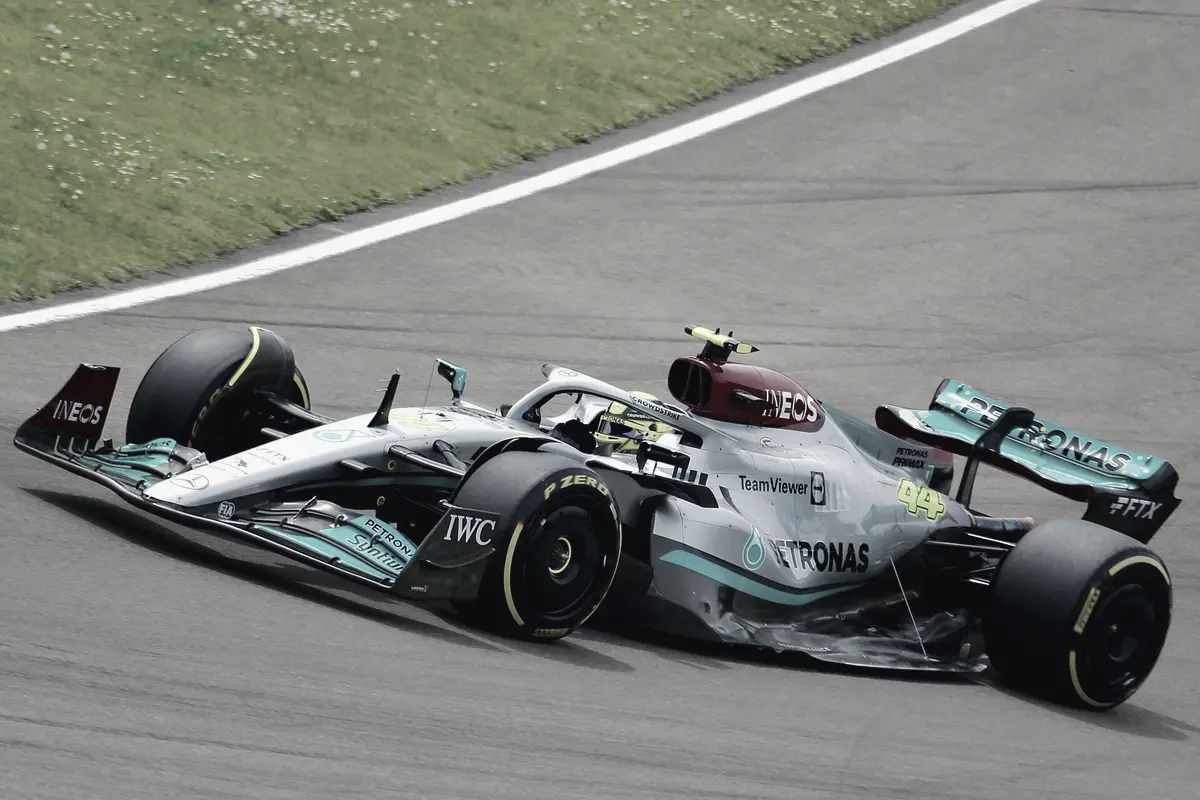
Lewis Hamilton’s Mercedes W13 on the 2022 Emilia Romagna Grand Prix weekend. The 2022 cars made most of their downforce from the tunnels under the floor.
Photo: Roberto Monti, CC BY-SA 4.0, via Wikimedia Commons; colour-graded and cropped by The Second Grid (this adaptation is licensed under the same licence).
It had 2 parts. The first was closer checks on the planks and skids under the car, their design and their wear. The second was a metric based on the car’s vertical acceleration, giving a number limit on how much a car could oscillate. The exact formula was never published. The metric was delayed to the Belgian Grand Prix at the end of August 2022, and the FIA also moved to check how much teams’ floors were flexing (The Race). For 2023 it went further and raised the edges of the floor (The Race).
Does porpoising still happen in 2026?
The 2026 rules attacked the cause. The FIA’s own description of the new cars is “a partially flat floor and a lower-powered diffuser, which will reduce the ground effect and the reliance of the cars on ultra-stiff and low set-ups” (FIA). Formula1.com put it more bluntly: the tunnels are gone, replaced with a flatter design, and the suction forces “don’t disappear with a flat floor but they are greatly diminished”.
4 seasons
of Venturi-tunnel floors, from 2022 to 2025. The 2026 rules switched to a partially flat floor and a lower-powered diffuser.
Source: FIA, 2026 regulations announcement (June 2024); Formula1.com (January 27, 2026)
Teams expected that to end it. Mercedes’ Andrew Shovlin predicted no porpoising in 2026 (Motorsport.com), and after the first test in Barcelona in January George Russell said it was no longer an issue for the car (PlanetF1).
So F1’s answer to porpoising was a less powerful floor, with the downforce found elsewhere.
Questions people also ask
- Why is it called porpoising?
- Because the car rises and dips at speed the way a porpoise does when it swims along the surface.
- Is porpoising the same as bouncing?
- Not quite. Porpoising is aerodynamic: the floor stalls and recovers in a loop. Bouncing is mechanical: a car run very low and stiff hits the track over bumps. Mercedes said in June 2022 that the two look almost identical from outside.
- Do 2026 F1 cars porpoise?
- The 2026 rules were written to stop it, with a partially flat floor and a lower-powered diffuser. Mercedes said after the first test of 2026, in January, that porpoising was no longer an issue for its car.
Key facts
| What it is | An aerodynamic oscillation: the floor stalls, the car rises, the flow reattaches and the car is pulled back down |
|---|---|
| When | The ground-effect cars of 2022–2025, worst early in 2022 |
| Not the same as | Bouncing: a stiff, low car hitting the track over bumps (Mercedes, Baku 2022) |
| FIA response | Technical directive of June 2022: plank and skid checks plus a limit on vertical oscillation, enforced from the Belgian GP |
| 2026 rules | “A partially flat floor and a lower-powered diffuser”, which reduce ground effect (FIA) |
Sources (11, 2 primary, marked ●)
- ● FIA unveils Formula 1 regulations for 2026 and beyond (June 2024), FIA
- ● 2022 Azerbaijan Grand Prix race result, Formula1.com
- 2026 regulations explained: all you need to know about F1’s new aerodynamics (January 27, 2026), Formula1.com
- What is porpoising and why are 2022 F1 cars doing it? (March 10, 2022), The Race
- Mercedes reveal new cause of Hamilton Baku pain (James Vowles, June 16, 2022), GPFans
- “You’re just praying for it to end”: Lewis Hamilton reveals back pain in Azerbaijan (June 12, 2022), TNT Sports
- FIA issues technical directive to combat porpoising, cites driver health (June 16, 2022), Motorsport Week
- FIA’s controversial technical directive delayed to Belgian GP (July 8, 2022), The Race
- Gary Anderson: the FIA’s 2023 plan to fix F1 porpoising explained, The Race
- Mercedes: no porpoising in 2026, but new F1 rules aren’t “straightforward” (November 8, 2025), Motorsport.com
- George Russell hails end of Mercedes porpoising thanks to 2026 F1 rules (January 31, 2026), PlanetF1
Spotted an error? Email contact@thesecondgrid.com with your source. Confirmed fixes go on the corrections log.
Related long-form episodes
All articles
Banned F1 cars that never cheated, ranked by how fast F1 killed them
Six Formula 1 cars were legal when they raced and banned anyway.
F1 wind tunnel testing restrictions: why the champion gets the least tunnel time
Formula 1’s champion gets 70% of the baseline wind tunnel allowance; the team that finishes last gets 115%.