F1 logistics: how 1,200 tonnes of kit reaches the next race in 14 days
Up to 1,200 tonnes of equipment leaves every Formula 1 race weekend, and it has 14 days to be rebuilt on another continent. Most of the garage never makes that trip. It went by sea months earlier.
By The Second GridChecked against 7 sources (3 primary)Updated
5 min read · 8:28 video
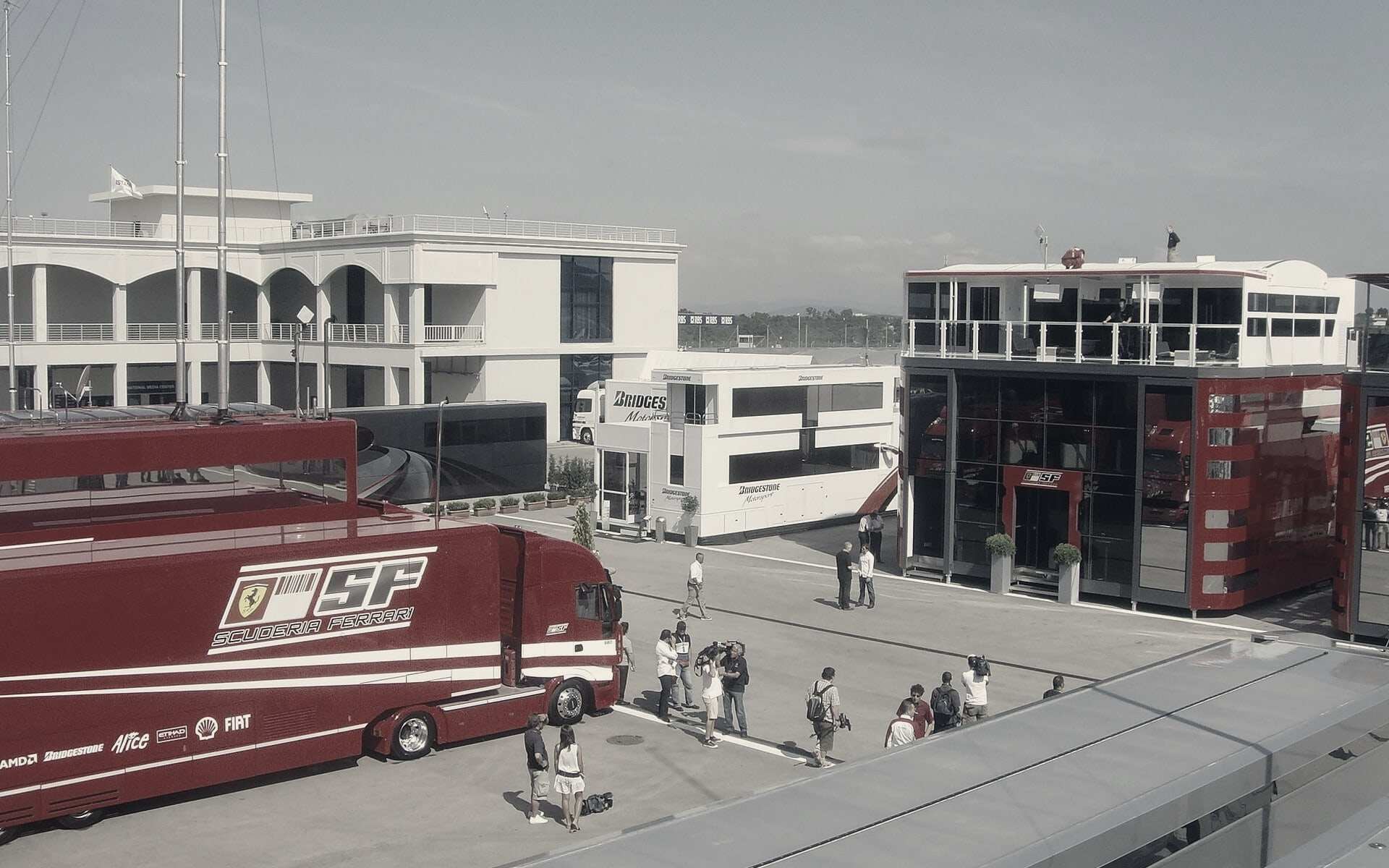
Ferrari's truck and motorhome in the Istanbul Park paddock. Photo: Homonihilis, CC BY 3.0, via Wikimedia Commons; colour-graded and cropped by The Second Grid.
Formula 1 doesn’t fly its whole paddock from race to race. It flies the cars, the power units and the spares it can’t do without, and most of everything else went by sea months earlier.
Up to 1,200 tonnes of equipment leaves a Formula 1 race weekend, according to DHL, the sport’s official logistics partner. That’s roughly the weight of 900 small cars. It all has to be set up again on another continent within 14 days, and the 2026 calendar asks for that 23 times.
The packing starts before the race has even finished. By the time the trucks pull out, the garage that stood there all weekend has already been taken apart.
Some of it flies
On a long-haul weekend the operation typically uses 5 Boeing 777 freighters, with about 40 pods to each aircraft, loaded to a schedule that doesn’t move (FreightWaves).
Freighters on a long-haul race weekend
5 × Boeing 777
About 40 pods to each aircraft, loaded to a fixed schedule
Source: FreightWaves — The extreme logistics behind Formula One’s global circus
Those aircraft don’t carry the garage. They don’t carry the hospitality unit, the fan zone or most of the tools that were on the garage floor that morning, either.
Almost none of that travels with the team. It was shipped by sea months earlier to the continent where it would be needed. Each team has 5 or 6 copies of it waiting on other continents for later in the season.
Follow the freight from the flag to the rebuild
The freight operation doesn’t wait for the chequered flag. A race weekend runs 3 crews in rotation: one bringing equipment in, one running the paddock during the racing, and one packing up. The packing crew is already at work while the cars are still on track.
The route in numbers
| Stage | Figure |
|---|---|
| Crews rotating through a weekend | 3 |
| 777 fuel efficiency vs the 747 it replaced | About 18% better |
| Logistics specialists travelling to each race | 35 |
| Kit on site before the race | 14 days |
| Broadcast equipment | More than 330,000 lb (about 150 t) |
Source: FreightWaves — The extreme logistics behind Formula One’s global circus
The cars come apart first. An F1 car used to travel in one piece. Now it’s dismantled, and each part is pressed into a foam slot cut to its exact shape, inside a protective pod built to fit an aircraft container. A part that moves in transit arrives broken, so nothing is packed by eye.
The pods leave the circuit by road. In Europe that means a fleet of 51 biofuel-powered trucks, and 14 of them carry nothing but the generators that power the paddock.
At the airport the pods go onto the freighters. The 777 is about 18% more fuel-efficient than the 747 it replaced on these routes, and the fleet was changed so the same trip would cost less.
After that, the hard part is paperwork. Race freight crosses borders on a deadline the calendar set long before, and 35 logistics specialists travel to every event with it.
The kit lands at bare concrete 14 days before anyone races. The unload runs in a set order. Priority pallets of garage materials come off first, so the build crews can get started before most of the equipment, and most of the people, have arrived.
Then the rest goes in: tools, timing gear, hospitality and broadcast equipment. The broadcast kit alone weighs more than 330,000 pounds, about 150 tonnes. By the time the cars are unpacked, the garage around them has been up for days.
The weekend runs, the flag falls and the packing crew starts again. From here the freight goes 2 different ways.
What flies and what sails
F1 sorts everything it owns into 2 piles: equipment that stops the car running if it’s missing, and everything else.
Two piles: what flies and what sails
| Pile | What is in it | How it travels |
|---|---|---|
| Stops the car if late | Cars, power units, spares nothing on site can replace | Air, on the freighters |
| Non-essential to on-track performance | Garage structures, hospitality, fan zones, tools | Sea, as 5 to 6 duplicate kits per team |
Source: FreightWaves — The extreme logistics behind Formula One’s global circus
The first pile flies. That’s the cars, the power units and any spares that nothing already on site can replace. It’s the freight with the deadline, and it’s what goes on the 5 aircraft.
The second pile is bigger, and it doesn’t fly at all: garage structures, hospitality suites, fan zones, tools and garage equipment. FreightWaves calls it “non-essential to on-track performance”. If it turns up a month early, nothing bad happens.
So it does turn up a month early. Each team keeps 5 or 6 duplicate kits, shipped by ocean freight and stored on each continent, then moved to the circuit by train or truck when its race comes round (DHL). One set flies, and the others are already in place.
That means the garage you see on TV this weekend probably isn’t the one you saw last week. It’s the same design, the same team and the same paint, but it’s a different set of kit, and it has been sitting on that continent for months.
Nobody moves 1,200 tonnes 23 times a year. F1 moves the smallest share it can at speed, and keeps copies of the rest so they never have to hurry.
Across a whole season the numbers are still big. In 2021 the operation moved 1,540 tonnes of equipment over more than 74,500 miles. Meanwhile most of the kit it was responsible for stayed put deliberately, in a warehouse on the right continent.
The cost: an estimated $8m a season
Teams don’t publish what they spend on freight, so every number here is an estimate. The best industry figure available is about $8m per team per season, rising towards $10m for a team with a heavy run of long-haul races (Yahoo Sports).
Freight cost per team per season
About $8m
Industry estimate, not a filed figure; up to $10m on a heavy run of long-haul races
Source: Yahoo Sports — What shipping really costs F1 teams
The 2026 cost cap has a base of $215m for a season of 24 races or fewer (FIA Financial Regulations, Article D4.1.2). On that estimate, freight takes roughly 4% to 5% of the cap. None of that money makes the car faster. It goes on getting the car to the right country. Wind tunnel time is the opposite: it does make the car faster, which is why F1 rations it run by run.
Deciding what gets to travel fast
The most important call in this whole system is which items are allowed to travel quickly.
Speed is the most expensive thing you can buy in freight, and you pay for it item by item. So someone had to go through a 1,200-tonne inventory and ask, for each item, what happens if it’s late. A power unit: the car doesn’t run. A garage panel: nothing, as long as a copy is already on the right continent.
The cars, the power units and the spares that nothing on site can replace go on the 5 freighters. The garages, hospitality suites and fan zones go by sea, in 5 or 6 copies already in place on each continent. That split is what lets F1 race on another continent 14 days later without flying everything it owns. It still costs a team an estimated $8m a season, roughly 4% to 5% of the $215m cost cap.
So when the crew strips the garage after the flag, that building isn’t going to the next race. A copy will be standing on another continent within 14 days. This set is going on a boat.
Key facts
| Freight per race | Up to 1,200 tonnes |
|---|---|
| Kit arrives at the track | 14 days before the event |
| Sea-freight duplicate kits | 5 to 6 per team |
| Flyaway airlift | Typically 5 Boeing 777 freighters, about 40 pods each |
| European road fleet | 51 biofuel trucks, 14 carrying only generators |
| Travelling logistics specialists | 35 at every race |
| Freight cost per team per season | About $8m (industry estimate, not a filed figure) |
| 2026 calendar | 23 rounds |
Sources (7 · 3 primary, marked ●)
- ● Formula 1 — DHL
- ● 2026 F1 race calendar — Formula 1
- ● 2026 F1 Regulations, Section D: Financial Regulations (F1 Teams), Issue 07, Article D4.1.2 — FIA
- The extreme logistics behind Formula One’s global circus — FreightWaves
- Inside F1 logistics — DHL
- What shipping really costs F1 teams — Yahoo Sports
- Explained: What is the F1 cost cap and why has it gone up? — Formula 1
Spotted an error? Email contact@thesecondgrid.com with your source. Confirmed fixes go on the corrections log.
Shorts on this story — open on YouTube


Read next
All articles
Business
The F1 budget cap is now $215m. Here’s why it isn’t a raise
Formula 1’s cost cap rises from $135m to $215m for 2026. By the FIA’s own account, the extra $80m covers inflation and costs that used to sit outside the cap. It isn’t new money to spend.
5 min read · 10:29 video
Rules & Tech
F1 wind tunnel testing restrictions: why the champion gets the least tunnel time
Formula 1’s champion gets 70% of the baseline wind tunnel allowance; the team that finishes last gets 115%. How the sliding scale works, and what happened when Red Bull’s allowance was cut even further.
5 min read · 8:47 video
Business
How much does it cost to reach F1? A ladder that bills you for winning
Winning Formula 3 pays €300,000. The Formula 2 season it has to be spent on costs €2–3 million, and the Super Licence points table means skipping that season is not an option.
6 min read · 18:16 video