How much does it cost to reach F1? A ladder that bills you for winning
Winning Formula 3 pays €300,000. The Formula 2 season it has to be spent on costs €2–3 million, and the Super Licence points table means skipping that season is not an option.
By The Second GridChecked against 9 sources (2 primary)Updated
6 min read · 18:16 video
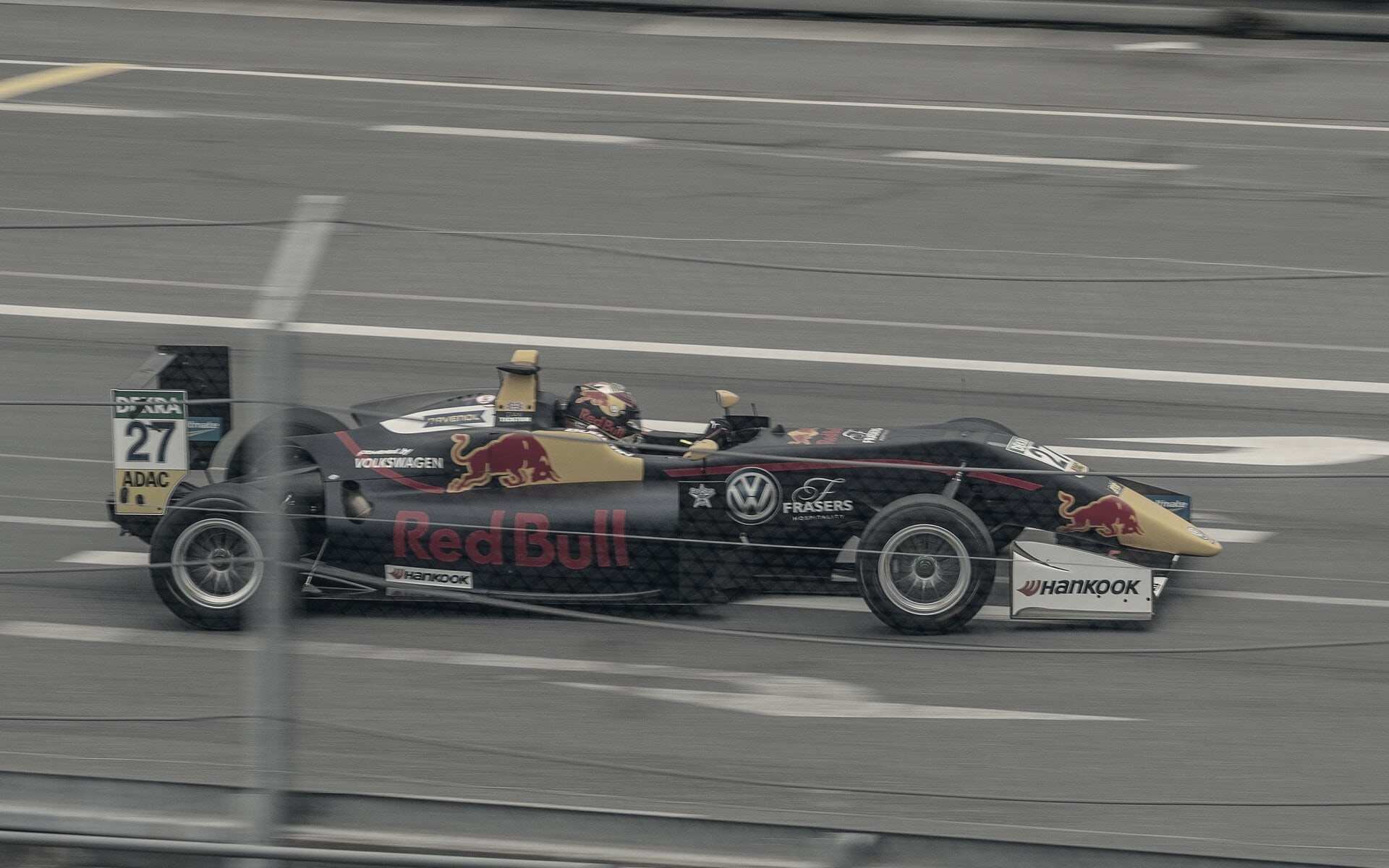
FIA Formula 3 European Championship, Norisring, 2018. Photo: facing-my-life (Flickr), CC BY 2.0, via Wikimedia Commons; colour-graded and cropped by The Second Grid.
Win the FIA Formula 3 championship and you get €300,000. The catch is that the money has to go towards a season in Formula 2, and that season costs a driver €2–3 million.
The series announced the prize fund on Formula1.com: €300,000 for the champion, then €250,000, €200,000, €150,000 and €100,000 down to fifth. That is €1 million split between some of the best young drivers in the world. It’s a lot of money for driving well, and a small fraction of what it is supposed to pay for.
The prize is a voucher
The money comes with a condition. The €300,000 only goes to the Formula 3 champion if they race in Formula 2 the following season. A driver who skips that step can’t save the prize for later. It passes down the standings to the next driver who is moving up.
FIA F3 prize fund by championship position, from 2025
Source: Formula1.com — Formula 3 announces €1 million prize fund for top-five drivers from 2025 onwards
So in practice it works like a voucher. It can be spent on one thing, and it expires if it isn’t.
Pirelli adds another €300,000 for the champion on graduating, which makes €600,000 the most the sport will give anyone for winning Formula 3. Against a €2–3 million season, that covers between a fifth and a third of the next step.
The other €1.4–2.4 million is the driver’s problem. A driver who can’t find it loses the prize as well.
Pricing the ladder, rung by rung
Every driver on the Formula 1 grid started in karting. The kart itself isn’t expensive by motorsport standards. The cost comes from racing it again and again in the international championships where the right people are watching. That means travel, hotels and a season that is often run by a parent with a van.
French F4 season with the FFSA Academy, before VAT
€145,500
18 races across 6 events, 2 test days; further testing, travel, accommodation and damage not included
Source: Go To The Grid — Formula 4 France: technical specifications and budget
We haven’t put a figure on a karting season or a full FIA Formula 3 budget here. Every number we found traced back to a blog quoting another blog.
What isn’t in dispute is how karting works as a filter. It is where the field gets sorted for the first time, partly by talent and partly by who can afford to keep turning up.
Formula 4 is the first step with a proper car and a published price. French F4, run by the FFSA Academy, puts its season at €145,500 before VAT. That makes it one of the cheapest structured routes into single-seaters in Europe. The money buys 18 races across 6 events, the car, its maintenance and 2 days of testing for the whole season.
The price also lists what it leaves out: further testing, travel, accommodation and damage. That last one matters. F4 is where a 16-year-old finds the limit, usually by going past it, and the budget assumes they won’t crash. Most of them will.
The F4 champion gets €100,000. That doesn’t cover the season they have just driven.
Formula 2, where the driver is the customer
Seats aren’t simply handed out on results. They get negotiated over the winter, on the phone, and a good championship finish helps without paying the bill.
Bruno Michel, CEO of both Formula 2 and Formula 3, is open about why costs have gone up. “The safety of the car,” he told Pit Debrief, “increased the cost quite heavily.”
That’s a fair point. Part of what the money pays for is a teenager walking away from a heavy accident. The price can be defended. The trouble is who it keeps out.
At the top of the ladder, an F2 season costs €2–3 million, and the driver pays it. They, or their family, a sponsor or a manufacturer’s academy, pay a team to drive its car on the last step before Formula 1. Some are backed by the big junior programmes, but the money still flows from the driver to the team. It’s the reverse of Formula 1, where the team pays the driver and driver salaries sit outside the cost cap.
Every step costs several times the one below it, and pays out a fraction of the one above.
A driver who can’t fund F2 might plan to stop at Formula 3. The Super Licence rules don’t allow for that.
30 points against a gate of 40
To start a Grand Prix you need a Super Licence, and you can’t just buy one. You have to qualify through the points table in Appendix L of the International Sporting Code, which asks for at least 40 points counted over 3 years.
Super Licence points by championship finish (40 needed)
Source: FIA — Appendix L to the International Sporting Code (2026), Supplement 1: Super Licence points
The top 3 in the F2 championship each get 40 points. Finish anywhere in that group and you have the full requirement from a single season.
The F3 champion, with the trophy and the €300,000, gets 30.
The F3 champion gets 30 points. The requirement is 40. Winning Formula 3 does not, on its own, qualify you to race in Formula 1.
There is a second requirement as well. A first-time applicant must have completed at least 80% of each of 2 full seasons of single-seater racing, whatever their points total. One brilliant year isn’t enough.
Put those rules together and they push drivers the same way. The F3 prize can only be spent on an F2 season, and an F2 season is the realistic route to 40 points. The rules mean drivers have to pay for the next step, and the prize covers part of it.
Who is funded
The first driver to collect the new prize was Rafael Câmara, the 2025 Formula 3 champion with Trident. He stepped up to Formula 2 for 2026 with Invicta Racing, which met the prize’s condition. He is also a Ferrari junior.
That’s no criticism of him. He won the championship on the road, and he did everything the ladder asks. Even so, the biggest prize on offer couldn’t cover the step up on its own. He still needed backing on top of it.
That is how the trophy works in practice. It helps a driver convince somebody with money, and that person pays.
Asked about drivers who can’t complete a season, Michel was candid: “it’s not related to the cost, but it’s related to the fact that for some drivers, it’s more difficult to find money.” He has also said that critics of what his championships cost “don’t know really what they’re talking about”.
On the price alone, he has a point. Given the safety engineering in these cars, F2 and F3 aren’t obviously overpriced.
The issue is who gets through. A rule that needs €2–3 million to pass will favour drivers who can raise €2–3 million, whether the price is fair or not. When the reward for winning is a fraction of the cost of carrying on, backing decides more than speed does.
The more you win, the more the licence costs
The bills don’t stop once you’re in F1. A Super Licence has to be renewed every year, and the renewal has a formula: a base fee of about €10,400, plus about €2,100 for every championship point scored the season before.
Super Licence fees billed for 2024
| Driver | Points scored the season before | Fee |
|---|---|---|
| Max Verstappen | 575 | €1,217,900 |
| Logan Sargeant | 1 | €12,500 |
Source: Motorsport.com — Max Verstappen hit with shocking F1 Super Licence fee
In 2024, Max Verstappen, the champion with 575 points, was billed €1,217,900 for the licence that let him defend his title. Logan Sargeant, who scored 1 point, was billed €12,500.
It’s the same licence, but Verstappen’s fee was nearly 100 times bigger, purely because he scored more points. For a driver at his level the money barely matters. The pattern is still the same one the whole ladder follows.
In F4, the budget leaves out the crashes you will have. In F3, the prize for winning can only be spent on something worth several times as much. In F2, you pay to race. In F1, the licence itself is priced on your results. At no point on the ladder does winning pay for the next step.
Every driver on the grid has crossed the funding gap described here, and none of them did it on prize money, because the numbers don’t add up. A family, a sponsor, a federation or a manufacturer paid the difference.
When the grid lines up for a Grand Prix, you’re watching the fastest drivers who were also able to get funded.
Key facts
| FIA F3 champion’s prize | €300,000 (paid only if he races F2 the next season) |
|---|---|
| Pirelli top-up for the F3 champion | €300,000 on graduating to F2 |
| One F2 season, paid by the driver | €2–3 million (reported) |
| French F4 season (FFSA Academy) | €145,500 ex-VAT, damage not included |
| Super Licence threshold | 40 points over 3 years |
| Points for winning F3 | 30 |
| Super Licence fee (2024) | ~€10,400 + ~€2,100 per championship point |
Sources (9 · 2 primary, marked ●)
- ● Appendix L to the International Sporting Code (2026), Supplement 1: Super Licence points — FIA
- ● Formula 3 announces €1 million prize fund for top-five drivers from 2025 onwards — Formula1.com
- The beginner’s guide to the Formula 1 Super Licence — Formula1.com
- F3 prize fund — Autosport
- FIA F3 offers prize fund for top five drivers to reach F2 — Formula Scout
- Formula 4 France: technical specifications and budget — Go To The Grid
- Max Verstappen hit with shocking F1 Super Licence fee — Motorsport.com
- F2 and F3 CEO Bruno Michel on affordability and accessibility of feeder series — Pit Debrief
- FIA F3 champion Rafael Câmara joins Invicta for 2026 F2 graduation — Formula Scout
Spotted an error? Email contact@thesecondgrid.com with your source. Confirmed fixes go on the corrections log.
Read next
All articles
Business
The F1 budget cap is now $215m. Here’s why it isn’t a raise
Formula 1’s cost cap rises from $135m to $215m for 2026. By the FIA’s own account, the extra $80m covers inflation and costs that used to sit outside the cap. It isn’t new money to spend.
5 min read · 10:29 video
Drivers
Charles Leclerc’s Ferrari gamble: why he signed again after 7 seasons without a title
Charles Leclerc signed with Ferrari again on 3 June 2026, after 7 seasons without a title. He crashed out at Monaco 4 days later and won Silverstone a month after that.
5 min read · 14:09 video
Drivers
F1 drivers who never won again: 8 last wins, and the contracts signed first
Jean Alesi started 201 Grands Prix and won once. Seven other careers follow the same pattern: the last win came shortly after the driver picked a team for something other than the car.
7 min read · 11:28 video